Kickass Women

History is filled with women doing all kinds of kickass stuff.

Smart Girls

Watch these girls... they're going places!

Inspiration

Need a dose of inspiration? Here you go.

SRPS Entertainment

Some of my entertainment recommendations with awesome female characters and stars.

She's Crafty!

Some of the awesome items made by kickass women!

Showing posts with label women in sports. Show all posts

Thursday, November 9, 2017

Florence Chadwick - record-setting open water swimmer

Florence Chadwick (November 9, 1918 – March 15, 1995) was an American long-distance open water swimmer who became the first woman to swim across the English Channel in both directions, as well as crossing the Catalina Channel, the Straits of Gibraltar, the Bosporus, and the Dardanelles.


She'd always loved swimming, and was extremely competitive. From the age of six on, she was determined to swim in and win as many competitions as possible. Her childhood heroine was Gertrude Ederle, the first woman to swim the English Channel, and what little Florence wanted most was to follow in her wake by completing her own channel swim. When she was 10 she became the youngest person to swim across the mouth of San Diego Bay, setting a precedence that would eventually guide her swimming career.

She trained with several internationally known swim coaches, and winning cups and titles in both open water and pool events. While in high school, she traveled from San Diego to Los Angeles to swim with the LA Athletic Club swim team, where one of her teammates was Esther William. Florence cut her amateur swimming career short in order to appear in one of Esther William's films, although she didn't enjoy synchronized swimming. She preferred open water competitions.

After graduation, she attended night classes studying law while working in her family's restaurant business during the day, teaching swimming classes, and training as often as possible. Her first marriage ended when her husband became jealous of the time she spent swimming. Her second ended when she discovered her husband with another woman. Unhappy, she knew she needed to make a change. She quit night school, and began looking for a way out of the family business. In 1948, she was sure she'd finally found a way to pursue her lifelong dream to swim the English Channel when she read an article about a woman making a great deal of money working for an oil company in Saudi Arabia.

Florence knew she could train in Saudi Arabia while also making enough money to afford the otherwise prohibitively expensive quest to swim the English Channel -- she'd need a crew and boats as well as travel expenses, all of which was impossible on her restaurant salary. After taking a few business exams she was hired, and without telling anyone of her plans, she began to prepare for her new adventure.

In Saudi Arabia, she trained relentlessly while saving money. At the end of her contract, she'd managed to save $5000, which would be just enough to pay for the time spent training and for the crew to help her during her attempt. She arranged to return to the US by way of France. She trained for two months in the cold water off the north of France. She learned about an English Channel swim competition sponsored by the London Daily Mail, but when she tried to enter they gently rebuffed her, telling her the contest was for serious athletes only. Undaunted, she scheduled her attempt two days before their race.

Shortly before 3 am on August 8, 1950, she walked out into the water off the coast of France and began her trip across the channel. Unknown to her at the time, another woman would also attempt to swim across that day. Shirley May France had even brought her own film crew and had arranged for several boats to carrying reporters to record her attempt. While Shirley had to quit because of cramps and nausea, the reporters still had a fantastic story to run when they saw Florence swimming into shore on the English side of the channel, beating Gertrude Ederle's world record from decades earlier.

Overnight she became and international swimming celebrity, launching her professional swimming career. Sponsors were more than happy to finance her training and channel swims. She completed the more difficult crossing of the English Channel by swimming from England to France, becoming the first woman to have swam it in both directions. Over the course of the next few years she completed 16 other long-distance swims, becoming the first woman to swim the Catalina Channel in California, and re-crossing the English Channel twice more, besting her previous records each time.

You can read an excellent biography about her: "Against the Current: Florence Chadwick in and out of the water" published in the San Diego Reader in 1982.

I need your help to tell the stories of amazing women from history!
If you like what you read here, please share this post with your friends.

Thursday, June 15, 2017

Margaret Abbott - unsuspecting Olympian

Imagine you're a wealthy young woman from Chicago who has traveled to Paris with your mother in order to take art lessons from the greats -- Dumas and Rodin -- and while you're there you join a golfing competition with some other wealthy white women for kicks. You win, accept a beautiful porcelain bowl, return to your studies, and live the rest of your life totally unaware that you're the first American woman to win an Olympic event.

That's exactly what happened to Margaret Abbott (June 15, 1878 – June 10, 1955). She was only 22 when she and her mother went to Paris. She had no idea that golf match competition was part of the 1900 Olympic Games, nor that by winning she was making history.


Actually, no one really knew until 1996 when University of Florida professor Paula Welch, who taught sports history tracked down the details of that year's Olympics -- a challenging bit of detective work as the Paris Games were so poorly organized, and the International Olympic Committee (IOC) didn't officially add her golf match or other competitions to the list of Olympic matches until after the fact.

Thankfully because of Professor Welch's research, we now know that Margaret Abbott is the first official American woman Olympic winner.

The 1900 Paris Olympic Games was the first time women's sports were included in the official record. The IOC president as well as many other people were opposed to allowing women to compete, but the French Organizing Committee set up events, over the course of six months, for them anyway. It wasn't until later that year that the IOC approved some of the matches -- those that were considered more lady-like like yachting, tennis, and golf.

On October 3, 1900, Margaret Abbott, and her mother Mary Abbott, played in a tournament of 9 holes, where Margaret came in first with a score of 47, and her mother tied for seventh place. In fact, this is the only time in the history of modern Olympics where a mother and daughter both participated in the same event.

So I guess that means she made history twice that day.

To read more about her competition and the 1900 Olympics at Women Golfers Museum.

I can't do the work of SRPS without your your support!
If you like what you read here, please share this post with your friends.

Wednesday, June 14, 2017

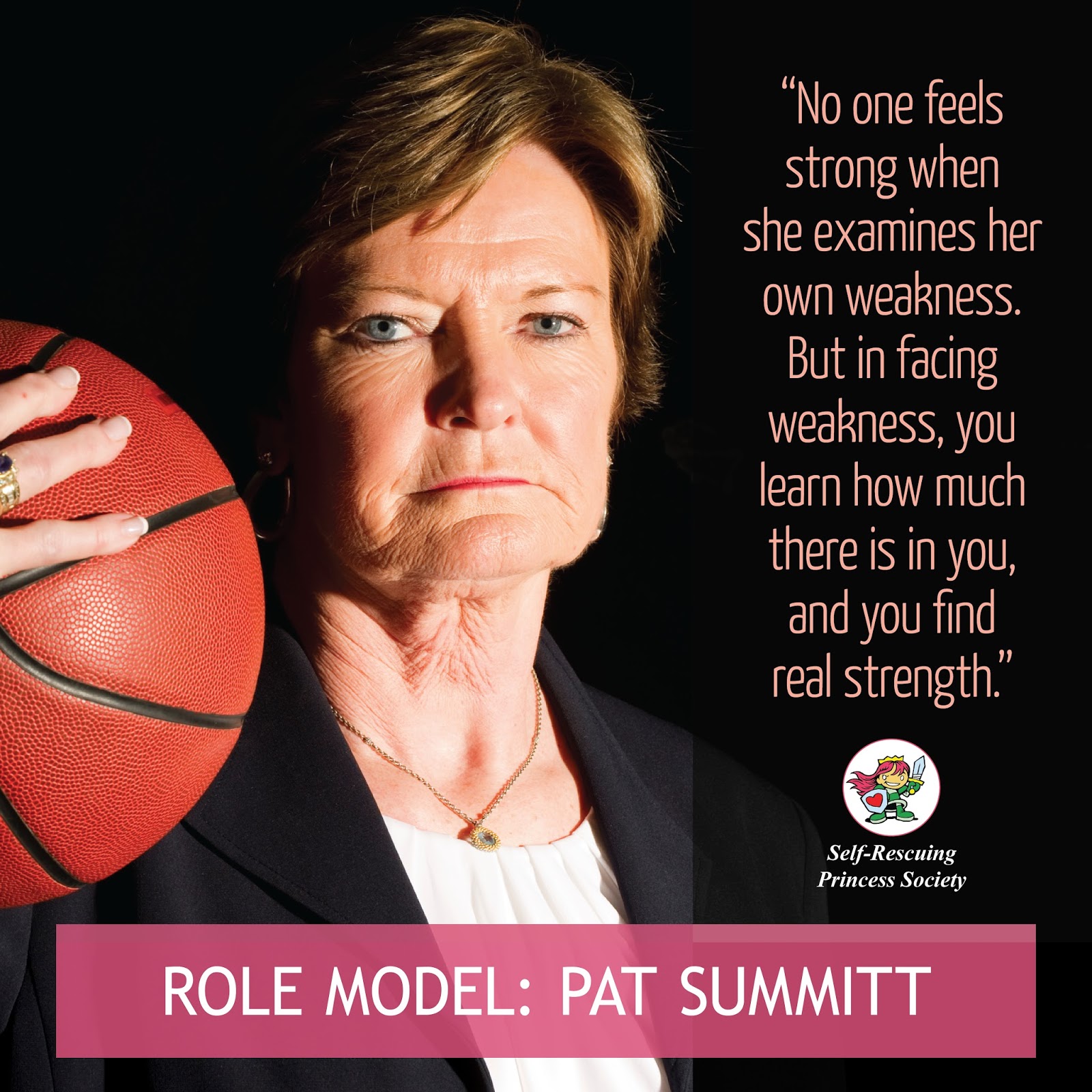
SRPS Role Model: Pat Summitt - basketball icon

Pat Summitt (June 14, 1952 – June 28, 2016) is best known as the inspirational basketball coach with a record-setting 1098 career wins, but how much do you know about her life and how her basketball career highlights the changing climate for women in sports?


Pat was born in Clarksville, Tennessee, into a family filled with sports fans and athletes. When she was in high school, her parents moved to a nearby town just so she could play basketball. This was years before Title IX, and her hometown school didn't offer a girls team.

When she enrolled in the University of Tennessee at Martin, she didn't receive an athletic scholarship like her brothers did, because colleges didn't have to offer parity in sports funding and scholarships. And still, she won All-American honors. And I have to wonder what role her college coach, Nadine Gearin, the woman who founded the UT-Martin women's team, played in Pat's career choice?

After graduating from UT-Martin, Pat took a position as a graduate assistant at the University of Tennessee (Knoxville), where she was also appointed as the new head coach of the women's basketball team, the Lady Vols, to replace the previous coach who quit abruptly. This was certainly a fortuitous turn of events for both Pat and UT. Her first season with the team, 1974-75, they won their district championship, setting a precedent that would define her career.

The next year, while still coaching another winning team, she was also earning her master's degree in physical education AND training as co-captain for the 1976 Women's Olympic team. They won the silver medal in the first-ever Olympic women's basketball competition.

She and her Lady Vols went on to have 38 winning seasons. In fact, she never had a losing season in her long coaching career. And when she coached the US Women's Team in the 1984 Olympics she took home a gold medal to go next to her silver.

When she retired, she had won eight NCAA championships, a NCAA women's record, with an astonishing 1,098 wins, the most in the entire NCAA history. I'm sure it's no surprise that she's an SRPS Role Model. This woman who had to chase her dream of playing basketball at a time when women's sports weren't taken seriously, went on to have a serious impact on women's sports by coaching some of the world's best players and bringing world-wide attention to women's basketball.

You can read more about her coaching career in this 1998 Sports Illustrated article "Eyes Of The Storm."

I can't do the work of SRPS without your your support!
If you like what you read here, please share this post with your friends.

Thursday, April 20, 2017

Role Model: Danica Patrick and her advice for living an adventurous life

"Give yourself permission to shoot for something that seems totally beyond your grasp. You may be surprised at your capabilities."
Danica Patrick has certainly lived her life by that advice, continually aiming for racing goals that might seem too far out of her reach. It's this kind of drive and determination that makes her a great Self-Rescuing Princess Society Role Model. Throughout her career, she has been a fierce competitor. She's won a couple of races and finished high in more than few others. And along the way made a place for herself in the history books.


She started her racing career at the tender age of 10, speeding around the go-kart track at the Sugar River Raceway. A few years later, while still a teenager, she was introduced to Lyn St. James, the first woman to win the Indianapolis 500 Rookie of the Year award in 1992. St. James invited Danica to be her guest at the 1997 Indy 500, where she was introduced to John Mecom, Jr., a former Indy 500 team owner. That meeting changed the course of her life.

Mecom sent her to the UK where she raced Formula Fords. She was only 16, but she was already working on her racing career; and already shooting for the stars. She stayed there for several years, honing her racing skills. In 2002 she moved back the US, and started driving for a team co-owned by David Letterman. In 2004, they put her on the roster for their IndyCar Series team for 2005.

In 2005 Danica Patrick joined a short, but impressive, list of women IndyCar drivers, including the remarkable Janet Guthrie who, in 1977, became the first woman to drive in the Indy 500. Danica performed exceptionally well in her debut Indy 500, even leading race for more than 20 laps. When other racers stopped to refuel, Danica stayed on the track, taking over the lead. It was a gutsy gamble that unfortunately didn't pay off for her this time. The leaders eventually caught up to her, and because Danica had to slow her pace a bit to conserve gas, they were able to race past her. Despite losing the lead, she still made history when she finished in fourth place, the highest finish for a female driver in the Indy 500.

In 2006 and 2007, she continued driving in IndyCar events and finishing in respectable positions. All the while she continued to push herself to get better. On April 20, 2008, at the Indy Japan 300, she found herself in a similar situation where the leaders stopped to refuel, and again she grabbed the lead. Only now she had more experience and knew how to hold the lead. Her gamble paid off and she drove herself into the history books again, this time as the first woman to win an IndyCar race.

Danica Patrick signs an autograph for a young fan at RIR Toyota Owners 400
Danica Patrick signs an autograph for a young fan

Since then she has continued to race, even placing third in the 2009 Indy 500. But in the last few years she has transitioned from a full-time IndyCar racer to a NASCAR driver. And it's been a great change, for her and for the racing world in general. NASCAR offered her more opportunities to race, and more sponsors. And few would dispute the fact that she has had a positive effect on NASCAR popularity. Her presence on the circuit sparked a huge following of new fans, mostly women and girls excited to finally see someone like them on the track.

Over the last two decades, she's had an impressive career as a race car driver. And while her racing successes may have waned a bit in the last year or so, that probably just means she's looking for the next thing to set her sights on. Since the first time she took the wheel of car (or cart) she has continually surprised everyone around her with her capability to keep on pushing. She might not have met all her goals but she doesn't seem to mind too much. Maybe she's just enjoying the ride.

I can't do the work of SRPS without your your support!

Monday, April 17, 2017

Women in Sports: Anna Lee Aldred

Anna Lee Aldred - The first female jockey
(April 19, 1921 – June 12, 2006)

Anne Lee grew up around horses and learned to ride when she three years old, and was racing ponies at state fairs and amateur tracks around Colorado and Wyoming while she was still in grade school. As the daughter of a prominent race horse trainer, and with an older brother working as a jockey, it seemed natural to her to look for a career as a rider, even if it other folks didn't think it was appropriate for a young woman in the 1930s.


While she was growing up, her family traveled around the West to different race tracks where her brother would ride the family's prized racehorses. Following in his footsteps, when she turned 18 in 1939 Anna Lee applied for a professional jockey's license from the Agua Caliente Racetrack, a popular racetrack in Tijuana, Mexico, that drew people from all over Southern California. The staff tried everything they could think of to keep her out, but since there wasn't any rule expressly forbidding women jockeys they had to let her ride. Like the other jockeys she received a small wooden badge that served as a license, making her the first American woman to work as a professional jockey.

She worked as a jockey for six years, racking up an impressive number of wins. But in 1945, she finally hit her finally height and weight, which was just a bit too tall and heavy to continue working as a jockey. Undaunted, she simply switched horses, so to speak, and became a rodeo rider. She performed impressive stunts on a galloping horse like back bends or standing on a saddle. For her prowess, she was inducted into the National Cowgirl Hall of Fame in 1983.

Even after she married and settled down to raise a family, she continued to work with horses. She started a riding school in Southern California, teaching others the joy of horseback riding.

Read more about her in this Denver Post story from last year: "Aldred galloped into history as first female jockey in U.S."

I can't do the work of SRPS without your your support!
If you like what you read here, please share this post with your friends.

Friday, March 17, 2017

Women in Sports: Alice Greenough Orr

Alice Greenough Orr - Rodeo Queen
(March 17, 1902 – August 20, 1995)

Alice Greenough Orr claimed she was "born liberated" and she spent the rest of her life proving it. She grew up on a ranch in Montana where her father often let her work with the wild horses. Her stubbornness came in handy -- he figured if they got tired of trying to kick her off, they'd be tame enough for anyone else. While she was taming horses, she was also honing the skills needed to become an internationally celebrated rodeo star, and earn herself four saddle bronc championships.


Strong-willed as a teenager, she dropped out of school to deliver mail by horseback, covering a 35-mile route on horseback through three winters. Her goal at the time was to become a forest ranger, but when servicemen returned after WWI the government stopped hiring women.

Instead, in 1919 she and her sister Marge answered an ad looking for saddle bronc riders - an event deemed too dangerous for women riders in modern rodeos. After all those years taming wild horses, she easily earned a spot, and began what became her life's work: rodeo. She criss-crossed the US, covering nearly every state. She continued to win championships, her fame grew, and her touring schedule was expanded to include Europe and Australia. While touring Europe in the 1930s, she had tea with the Queen of England, then visited Spain where she rode fighting bulls into arenas before hopping off and leaving them for the matadors.

Back in the US, she continued touring, but broadened her involvement in rodeo organization, and branched out into stunt work in films and television. In 1936, she helped organize the Professional Rodeo Cowboys Association to help performers negotiate better treatment by tour operators, who sometimes shortchanged them. In the 1940s, she established her own rodeo tour, offering the first women's barrel racing events.

She was the first woman inducted into the National Cowgirl Hall of Fame, and one of the first women inducted into the rodeo division of the National Cowboy Hall of Fame.

Read more about her and other pioneering cowgirls

I can't do the work of SRPS without your your support!
If you like what you read here, please share this post with your friends.

Tuesday, February 21, 2017

Nike Women: Celebrating Arab Athletes

Another great ad about kickass women! This time from Nike, showing off several badass Arab female athletes.

What I love about many of the Nike Women ads is how they show the amazing strength of these athletes-- both physical and emotional -- as they push themselves to perform better. It's not a story we see very often when we look at the sports news. It's a sad fact that no matter where you live, women's sports are not valued anywhere near men's. And so it shouldn't be a surprise when girls' participation is low, despite the overwhelming evidence of the benefits of sports on improving self-esteem, school performance, and socialization in girls, as well as the improvements in physical and mental health.


Sure, we see more stories about women in sports during the Olympics, but every two years is a long time to wait for more inspiration. So, I kinda look forward to these advertisements, even though I am a little iffy on corporations co-opting the themes of women's empowerment.

More importantly, this ad addresses the cultural biases that may keep many Arab girls from engaging in sports by showing young women running or skateboarding in defiance of the disapproving looks from people they encounter on the street. Sometimes the hardest part of exercising is simply getting out the door. This ad asks, "What will they say about you?" And then answers with "they'll say you're strong. That you can't be stopped. That you always find a way." These are the messages I want every young woman athlete to hear and internalize.

Plus, the Nike ads use actual athletes! In this video you'll see:

Amal Murad, first female Emirati parkour coach
Arifa Bseiso, first Jordanian female boxer
Ines Boubakri, first female Tunisian fencing Olympic bronze medal winner
Zahra Lari, first female Emirati figure skater

To add more amazing women to mix, the narrator is Fatima Al-Banawi, a Saudi actor, and there's a cameo by Balqees Fathi, a Saudi singer.

The entire video is beautiful. I've watched it about a dozen times today, and each time I get chills when I see these brilliant, brave, and strong women. More like this, please!

I can't do the work of SRPS without your your support!
If you enjoy what you read here, please consider making a donation.

Monday, February 6, 2017

Simi Azimi - Shaolin Wushu Club director

Look at this sword-wielding badass woman!

That's Simi Azimi, leader of the Shaolin Wushu club in Kabul, Afghanistan, where she's teaching 9 other young women and girls the ancient Chinese kung fu martial art.

"I like to help girls in my country in order to improve their skills, so they can be the same as girls in other countries. Also, I want to help bring an end to violence against women in Afghanistan." Sima Azimi

Simi Azimi is only 20 years old, but she's already an award winning kung fu athlete. She trained in Iran for several years, but returned to Kabul to share her skills in the hopes of building support for a national team to participate in the Olympics. Martial arts are quite popular in Afghanistan, but only for men. Women's participation in sports in extremely limited, and especially for contact sports like kung fu. But Simi is hoping to change that.

Her father encouraged her to study martial arts when she was younger and the family was living in Iran. While in Iran she participated in competitions, winning a gold and bronze medal. Now, back in Kabul, he helps her continue her training. She uses her experience to encourage parents to allow their daughters to take lessons in kung fu for self-defense: once a thief grabbed her purse, but Simi fought back and ran him off.

But she also recommends martial arts for the mental and emotional benefits. "It's really effective for body and soul." And for the confidence that comes along with both the strength and mental training. Her students are mostly Hazara, a Persian-speaking minority in Kabul, but she's hoping to expand her class to include more girls from other ethnic groups.

It might be a tough goal to accomplish. Her students have to deal with increased abuse and taunts for breaking the social restrictions limiting activities for women, as well as the increasing dangers they face as a Shi'ite minority targeted by the Islamic State militants. But student Shakila Muradi says they aren't going to be deterred. "There are many people harassing us but we ignore them and follow our goals."

Read more about the Shaolin Wushu club.

See more beautiful photos by Mohammad Ismail featuring the Shaolin Wushu club.


I can't do the work of SRPS without your your support!
If you like what you read, please share this post with your friends.

Wednesday, December 7, 2016

Claire Smith - Honoring a pioneering reporter and inspiration

Last night, at the annual Baseball Writers' Association of America (BBWAA) dinner and awards ceremony, a new record was set as Claire Smith, longtime sports writer and coordinating editor of ESPN's news group, accepted the prestigious J. G. Taylor Spink Award, the highest award given sports reporting.

According to the ESPN news story about the event, she was given "a standing ovation when her election was announced, and she asked the other half dozen women in the room to stand alongside her as she spoke."

In her acceptance speech, she thanked "the guys that stood up to the athletes and teams and said that we are your peers and we deserve to be treated like you."

"I want to thank you as well as the women who walked the walk and fought the battles and got all of us to this point. No one does this by themselves.''

I heard this evening's PBS Newshour segment interviewing her, and I was filled with renewed inspiration to continue sharing the stories of trailblazers in every field, but especially in sports where it seems women continue to be left behind.


Her inspiration for writing comes from her love of the game and her passion for telling stories, but also her connection to the story of Jackie Robinson. "This sport taught this country how to grow up... it integrated 20-some years before [the rest of] the United States of America."

But while Major League Baseball may have been more accepting of people of color, it was much more difficult for her to work as a female reporter. "It was no contest, it was harder because of gender than race." Fortunately for Claire Smith, working with the Yankees, she was protected by their aggressive stance for diversity in the clubhouse, giving her easier access to do her job than women in other cities may have faced.

Her most dramatic instance of overt sexism came after the World Series playoff game between the Chicago Cubs and the San Diego Padres, when she went to enter the visiting team's locker room at Wrigley Field, and was denied entry because of a sexist policy by the Padres prohibiting women access to the clubhouse. This was a watershed moment, with the players and reporters standing behind her. The very next day, the brand new Commissioner of Baseball Peter Ueberroth set down the law giving equal access to all reporters with the proper credentials regardless of gender.

As someone who grew up watching baseball and loving the game, I have long been fascinated by the ways we talk about this sport and how it has influenced our understanding of larger social issues. I'm absolutely thrilled Claire Smith is getting the recognition she so richly deserves. She truly is an amazing role model for young women, and especially young women of color, to pursue their passions despite challenges they may face. Her strength of character and her courage to continue doing her job in the face of sexism and racism serve as an excellent example of what a true self-rescuing princess is capable of.

Brava Claire Smith!

I can't do the work of SRPS without your your support!
If you like what you read, please share this post with your friends.

Wednesday, October 26, 2016

Last Minute Halloween Costume Ideas


I don't know about you, but Halloween seems to sneak up on me every year. Fortunately, I've got a couple of cosplay things in my closet that I can fall back on, drawing on my years of attending nerdy conventions. But, if you're like me and Halloween popped up to surprise you again this year, here are some SRPS-approved costume ideas you can pull together quickly and easily featuring a wide range of kickass women!

Friday, September 23, 2016

SRPS TV Night: Pitch


I don't usually watch live TV. And I rarely watch TV at night. I'm a fan of catching up the next day or so via streaming or DVR. So, staying up to watch a TV show as it's being broadcast is reserved for the very best shows -- the shows I'm too excited about to wait even a few hours to watch.

So when I said I was going to stay up and watch Pitch last night at 9 o'clock -- when I'm typically ensconced in my nightly bath -- my husband was a bit surprised. To be honest, I was a little worried it wouldn't be worth the special treatment. Well... that worry was gone after the opening few minutes, when it was clear this was something special. By the first commercial break, I was "all in."

The real life build up for this show has been pretty much like the on-screen build up we see for Ginny's first pitch. At every turn in the first 20 minutes of the show, Ginny is inundated with reminders of the importance of her position and the sheer number of people who are either placing their own hopes on her, or are just waiting for her to fail to justify their own sexist beliefs.

That's a lot of weight to place on one person, or one show. In Ginny's case she flounders under this unfair burden. On the big day, with everyone watching, as you might expect, she has trouble focusing, distracted by thoughts of her father, the voices of her detractors, and her feelings of responsibility to the seemingly endless stream of young girls in the stands holding up "We're counting on you" signs.

I'm not going to spoil the show for you, but it's pretty obvious that eventually she does pull it together, with some help from some unexpected places as well as from some trust-worthy friends. And from her own sheer force of will, which, as we learn, she got from her father.

This is classic hero's journey stuff, and it makes for a fantastic emotional roller coaster ride. As much as I enjoy wish-fulfillment fiction, I have been craving a good hero's journey story with a kickass female lead. Seeing my heroes doing the hard work to overcome their challenges is the best source of inspiration for when I'm facing my own struggles.

For this show to be truly successful, we need to be emotionally invested in each of the characters -- love them or hate them -- and this pilot does exactly that, and perfectly so. We get to meet her teammates, her coach, her friends, and her father. We get to meet the people who've helped to make her who she is today through their love and support, or by their dismissal, or even out-right hate.

Honestly, I can't help but think of Ginny's struggles in this first episode as a kind of allegory for our expectations and reactions to this show, and on a broader scale, the often unrealistic responsibilities we place on anyone trying to break this kind of historic barrier. We have to acknowledge how our own hopes influence the way we view someone else's actions, and relax a little and give folks a little room to do what they're good at.
"You do this for you. You do this for your team or you don't go it all. Because you can't aim your pitches if you're aiming to please everyone." 
It is as true in life as it is on the pitcher's mound. After being totally wowed by the first episode, I'm hopeful that Pitch will live up to all of my baseball-loving expectations as well as my feminist hopes. We have a whole season to see how it goes. For now I'm going to relax a little and just enjoy the ride.

If you like the work I do here at Self-Rescuing Princess Society,
please check out my Patreon.

Thursday, August 11, 2016

Dipa Karmakar - Indian Gymnast

"Every gymnast needs to have a bit of anger in them... every sports person does."
On Sunday, August 14, 2016, Dipa Karmakar will continue her work of breaking new ground for Indian gymnasts as she takes to the floor in the vault finals at the Rio Olympics. Like Toni-Ann Williams, Dipa Karmakar is the first and only female gymnast to represent her country at the Olympics. Unfortunately, her road to Rio wasn't nearly as smooth as many of the other gymnasts. But, like every other athlete competing in Rio, what makes her an Olympian is her drive and determination.

Thursday, August 4, 2016

Toni-Ann Williams - Jamaican Gymnast

Gymnastics is one of those sports I was never very interested to participate in as a child. It probably had something to do with my intense fear of falling. I didn't play on the monkey bars. I was always quite content to stay put on the ground, thank you very much. But that didn't stop me from watching and admiring the amazing gymnasts of my era. When I was growing up, the best of the best were all from Soviet Bloc countries, which made it all the more special with American Mary Lou Retton won her gold in 1984. But even the coldest of Cold Wars could stop us from admitting the sheer power and beauty of Nadia Comăneci's "perfect 10" in 1976.

But you know, as much as I admired the gymnasts of my youth, I'm even more impressed with the young athletes of today. They keep pushing the boundaries, reaching out to bring more people of different backgrounds and different abilities into the sport.

One young woman to watch is Toni-Ann Williams, who will be competing for Jamaica -- the first ever female gymnast to represent that country in international gymnastics events, and now at the Olympics. Toni-Ann, who attends the University of California at Berkeley, is also the first gymnastics student-athlete to win a spot at an Olympic even in the school's history.

Thursday, December 3, 2015

Mildred Wiley - trail-blazing athlete

Some time ago I came across this photo while doing some research about women in sports. I just love this kind of action shot. I know just enough about track and field events to know that this is the high jump, and that she's hit the bar. She's clearly giving it her all, and while the camera angle could be better, I don't think it was set up this way to be scandalous, but rather to juxtapose her activity with the elegant calm of the people seated behind her. Sadly, where I found it there was no indication of who this woman was or where this photo was taken.


When I searched for the image, I found very little information about the athlete, other than her name: Mildred Olive Wiley. She has a very abbreviated Wikipedia entry, listing her birth and death, and the fact that she won a bronze medal in the high jump.
Mildred Olive Wiley (December 3, 1901 – February 7, 2000) was an American high jumper who won a bronze medal at the 1928 Summer Olympics.

After marriage she changed her last name to Dee and gave birth to five children. One of them, Bob Dee, was a prominent professional footballer at the Boston Patriots in the 1960s.
According to Wikipedia, this image was taken at the 1928 Olympics in Amsterdam. Perhaps this is her final jump, landing her on the podium, so to speak. They say a photo is worth a thousand words, but even a photo cannot tell you everything. And as a history nerd, "everything" is what I want to know. Who was she? What was her life like as a young athlete? What or who inspired her to take up track?

She was named the 1928 Massachusetts State Track Association's Athlete of the Year, and is listed as having attended Quincy High School. Interestingly, in the summer of 1928, she would have been 27 years old. That's more than a bit old for a high school student. Perhaps she was honored that year because of her Olympic performance, and the note about her high school was simply part of their listing protocol.

The year 1928 was remarkable in that it was the first time women were permitted to compete in Track and Field events in the Olympics. She and her fellow female track team members were walking out into a new experience at the Olympics. What was it like for her and the other women from around the world coming together in Amsterdam? Were they excited? What experience did she have for this level of competition? I kept digging.

By looking into genealogical records, I managed to find the text of her obituary from the The Patriot Ledger.
That same year [1928] she was also the United States indoor and outdoor champion in the women's running high jump. When her athletic career ended, she became the secretary to the New England Chapter of the Olympians. Born in Taunton, she was educated in Quincy and was a graduate of Quincy High School.
In addition to participating in the Olympics, she was quite active in other track and field competitions, winning medals in both indoor and outdoor events. I suppose that's not really a surprise, since one would need to train extensively for an Olympic debut. Here's where Internet-only research falters. I am certain there are plenty of articles in the local newspapers about her achievements, but they are likely stored on microfilm in the file cabinets of the local library, and haven't been made available online yet.

What was her life like after winning her Olympic medal? After she stopped competing, she got married, but apparently stayed active in the local organization of fellow Olympians. But still no mention of what she did aside from working as their secretary. Did she encourage her children to participate in sports? It would seem so since her son Bob Dee was a professional football player. But her girls too? What stories did she tell her children and grandchildren about her time as an athlete?

I went digging one last time, hoping to find just a sliver more of information, and I did. I found this article from the Christian Science Monitor published in 1992: "1928 Olympian Recalls How It Was." A few more of my questions were answered. She shared a bit about how she came to be involved in the high jump in the first place. Apparently, she started out as a swimmer, but her natural ability was evident from an early age.
Dee's jumping career began at her home near the beach. "I'd come in from swimming and we had a little hedge there and I used to hop over it," says Dee. When she was in her early 20s, her swimming coach, who also coached track, got her involved in the high jump.
What I find most interesting in this whole thing is that she was a woman in her twenties involved in sports. That's still somewhat unusual in this day and age, much less nearly 100 years ago, when women were still considered too delicate for competition. Not to mention the clothing restrictions and rules for decorum! It was only 20 years earlier that Senda Berenson Abbott was introducing women's basketball to her students at Smith College and shocking the public by asking her girls to wear looser-fitting dresses. And now we've got Mildred in shorts? As it turns out, those shorts were a subject of much discussion.
"They almost disqualified me because they said my shorts were too short," she recalls with a grin, "and look at what they wear nowadays." Mrs. Dee, who won the bronze medal in the women's running high jump, says she was always rolling her shorts up.

"I wanted them out of my way," she explains. The questionable shorts came to mid-thigh, according to the tall native of Wollaston, Mass.
As yes. That does sound like a true athlete! She's there to compete, not look pretty or obey some ridiculous gendered dress code. I still wish I could find out more about her life after the Olympics. Sadly, this is where the trail of online information pretty much peters out. She got married, raised her family, and made sure to watch the Olympics on television every four years.

I can't help but wonder what it must have been like for other girls and young women to see newspaper articles about these female athletes getting their chance to compete in the Olympics. I know growing up I was inspired by women like Billie Jean King, the same as girls today are fired up about Abby Wambach. Fortunately, I don't have to wonder too much. Mary Carew Armstrong, who went on to win a gold medal for the 4x100 metre relay at the 1932 Olympics had this to say in an interview she gave in 1993:
When the nineteen twenty-eight Olympic team came home from Amsterdam, Boston had four women on the team. I knew them a little bit, I was one of their admirers. They were heroines to everybody in the area. When I saw those girls, I decided right then and there, that's what I want. And I was only a kid. But, it did inspire me to see those four women. Later on I competed against them. Olive Hasenfus was a sprinter, Florence McDonald was an eight hundren-meter runner, Rena MacDonald was a shot putter, and Mildred Wiley was a high jumper. They got a large press notice. The write-ups about any meet were only about those people. That encouraged me. I said to myself, I didn't dare day it to anybody else, but I had decided, the next Games I'm going to be on tha team. Of course, I had such wonderful support from my coach. I was pretty good then. I was just entering high school, tenth grade. My coach would point to them at a track meet and say, "look what you could do." They were an inspiration to me.
(source: American Women's Track and Field: A History, 1895 Through 1980, Volume 1)
"They were an inspiration to me." And that, folks, is why it's so important to celebrate the stories of women in sports, as well as other pursuits. Can you imagine how difficult it must have been to be a young female athlete at the time? But to have such a great role model out there showing you it can be done and done well is inspirational. By the same token, while we're celebrating the current crop of amazing women in sports, we should also work to learn, preserve, and share the stories of the trail-blazers like Mildred Wiley.

If you like the work I do here at Self-Rescuing Princess Society,
please check out my Patreon.


You may also be interested in:

SRPS Shout-Out - Althea Gibson
"Shaking hands with the Queen of England was a long way from being forced to sit in the colored section of the bus going into downtown Wilmington, North Carolina." "I want the public to remember me as they knew me: athletic, smart, and healthy.... Remember me strong and tough and quick, fleet of foot and tenacious."
Another Double Hitter: Movie Review & Shout-out
I would have loved to have known about Doris Sams and the other professional womens baseball players when I was a girl! No telling how I would have used that info. I wasn't especially athletically inclined, but it certainly would have been inspirational anyway. I'm sure I would have devoured biographies about women ball players if I had found any, the same way I read through every book I could find on Amelia Earhart.
Happy Birthday - Amelia Earhart
[N]ow and then women should do for themselves what men have already done - occasionally what men have not done--thereby establishing themselves as persons, and perhaps encouraging other women toward greater independence of thought and action. Some such consideration was a contributing reason for my wanting to do what I so much wanted to do.

Tuesday, April 7, 2015

Sweet 16 - 16 Women College B-Ballers From History You Should Know

Will you be watching tonight's NCAA Women's Basketball Final? No matter who you're cheering for, it looks to be a fantastic match up between two excellent teams. UCONN and Notre Dame have both played quite well all season!

Just in time to celebrate the achievement of these talented young women, I've put together a list of just a few of the many other amazing women who've played an important role in helping women's college basketball players get where they are today.


1. Senda Berenson
While she was not a basketball player herself, she was instrumental for bringing the sport to women in college, and because of her work with the students of Smith College, her rules for women's basketball were published and shared widely, fueling the boom of women's college teams.

Interestingly, and indicative of the beliefs of the time regarding women and team sports, during the first women's match at Smith, Berenson had to agree that no men would be present to assuage the worries of the faculty that this would present their young ladies in an unfavorable light.


2. Clara Gregory Baer
Around the same time that Senda Berenson was working with the women of Smith College in the northeast, Clara Gregory Baer was doing the same at Newcomb College (now part of Tulane) in the south. In fact, she wrote and published her rules of "basket-ball" several years before Berenson. Interestingly, because of a misunderstanding between Baer and James Naismith (the inventor of basketball), Baer's rules included designated regions for players, which limited their movement during the game. These rules, having been incorporated into the unified rules of women's basketball, remained in effect in many parts of the country until the early 1960s. Baer's writings also included descriptions of the jump shot and one-handed shot, although neither actually appeared in play until the 1930s.


3. L. Margaret Wade
In 1930 and 1931, Wade played basketball for Delta State Teacher's College, where she studied health and physical education. During her career at Delta State, the team's record was 28-5-2. In only her second season there, she was made team captain, a role she also held in her junior year, when she was also named the MVP.

Sadly, that same year Delta State officials succumbed to pressures from outside sources claiming the game was "too strenuous for women" and dropped the program, leaving the players with nothing to show for all their hard work. Margaret and her teammates were so upset they burned their uniforms in protest.

After graduation, Wade played semi-professionally, and took a position as a physical education teacher at the high school level. where she coached several successful basketball programs. In 1959, she took an assistant professor position with Delta State and served as chair of the Women's Physical Education Department.

In 1973, likely a result of Title IX, Delta University asked Wade to help resurrect the women's basketball program. She happily agreed, and she led the Lady Statesmen to three consecutive national championships at the AIAW Women's Basketball Tournament, in 1975, 1976 and 1977. Her success as coach of Delta State brought women's college basketball to a wider public audience and she is credited with helping spark the surge of interest through out the 1970s.


4 & 5. Faye & Raye Wilson
While many colleges were cutting women's basketball programs, hundreds of amateur teams popped up around the country, holding matches under the auspices of the Amateur Athletic Union. These teams found it beneficial to operate within the AAU, since the AIAW hadn't been formed yet and the NCAA did not sanction women's basketball until 1982. The AAU gave them the structure needed to hold regular matches and national championships, while allowing the colleges to turn to private business to pay for scholarships, uniforms, and travel expenses.

From 1953-58 the Hutcherson Flying Queens of Wayland Baptist College were the undisputed queens the basketball court, tallying a 131-game winning streak and capturing 4 AAU national titles by 1958. Two of the brightest stars on this team full of excellent players were twin sisters Faye and Raye Wilson.

Faye and Raye and the rest of their team had to overcome varied obstacles to achieve their basketball success. Not only did much of society believe basketball was too rough for young women, their fellow classmates at the Baptist college were concerned about their moral standing. "They went to chapel and prayed for us every day,” said Raye. “They thought we were more tempted to commit a sin because we wore shorts."


6. Nera White
The fact that the coach of the winning Wayland Baptist College team called the star of their rival team the "greatest woman basketball player in history" should give you a clue to how amazing an athlete Nera White truly was.

She was an AAU All-American for fifteen years in a row, from 1955 to 1969. During that time, she led the Nashville Business College team to ten AAU national championships, and was the AAU MVP nine times.

While it may sound as though she was in college longer than even I was, that's not the case. Like the Hutcherson Flying Queens of Wayland Baptist College, the Nashville Business College team was part of the AAU. Players did not have to be enrolled at the school to play for the team. Still, I'm counting her as part of the women's college basketball dream team because of her incredible talent, and because so few college basketball programs existed at the time, forcing these women to take positions with these programs only loosely affiliated with schools.

She wasn't just a basketball star. She was a versatile softballer, playing center field, shortstop, and pitcher, honored as All-World in 1959 and 1965 for the ASA Fast Pitch softball team. She was the first woman to circle the bases in a remarkable ten seconds.


7. Joan Crawford
Crawford began her college basketball career at Clarendon Junior College. During her two years there, she helped to lead her team to the quarterfinals of the AAU national tournament in 1957, and she was an AAU All-American.

After she graduated with her associates degree, she was sought after by a number of AAU teams affiliated with four-year colleges. She was offered a scholarship to Wayland Baptist University, but chose to go to Nashville Business College instead. She began as a student, taking classes in the business program. But she dropped that and took a position as supervisor in the mail facility. She continued playing with the team for twelve seasons. Every year of her time there, she was named to the All-American team, and helped her team win the AAU National Championship ten times. She and Nera White became the dominant duo of the era. "We knew almost what each other was going to do. We didn't have to look or aim. A lot of times, in a fast break, I'd just throw it down to Nera, she'd just throw it down to me."


8. Lucia Harris
Shortly after the reinstatement of the women's basketball program at Delta State, Lucia Harris joined the Lady Statesmen, and helped lead the team to a 16-2 record. In her second year, the team made it all the way to the AIAW final, where they faced the powerhouse Immaculata University, three-time champions looking for their fourth win. Instead, Harris and her team served them their walking papers. Harris scored 32 points and 16 rebounds, for a final score of 90-81.

In 1975, Delta State was the only college team with an undefeated record. Harris lead the team in four games at the national tournament and was named as the tournament's MVP, scoring 138 points and 63 rebounds. And the nation was able to watch her do it all, since that year, for the first time in history, the championship game was televised nationally.

During the 1975-76 season, Harris continued to dominate the leader boards with a 31.2 points per game average, and scoring 1,060 points. Her team was invited to play a match in the Madison Square Garden, one of the first women's basketball game ever played there. Now a senior, Harris was the star of the show, scoring 47 points. Her team continued to excel, and again reached the AIAW finals, this time blasting the Louisiana State University team 68-55, winning their third consecutive title. Again, Harris was named the MVP.

Her overall college career record was 109–6, and she finished with 2,981 points and 1,662 rebounds, with a 25.9 average points per game. She graduated holding fifteen out of eighteen records at Delta State, and was awarded the first Broderick Cup in 1977.


9. Nancy Lieberman
The mid- to late-70s was an exciting era for women's college basketball. Increased national attention coupled with the passage of Title IX gave women's hoops a huge boost in support and viability. One of the powerhouses was Old Dominion University in Norfolk, Virginia. And Nancy Lieberman was one of their top stars, earning herself the name "Lady Magic."

She attended ODU from 1976 to 1980, and in that time she lead her team to two consecutive AIAW national championships, and one WNIT championship in 1978. In each of the four years she was at ODU, she led the team with 2,430 points, 1,167 rebounds, with a college average of 18.1 points per game. Her school records of 961 assists and 562 steals still stand today.

She was the first woman to win the prestigious Wade Trophy, named after Margaret Wade, two years in a row. After college, she was the first woman to play in a men's professional basketball league when she joined the USBL's Springfield Fame in 1986.


10. Ann Meyers
The same time Nancy Lieberman was ruling the court at ODU, Ann Meyers was dominating at UCLA, having been recruited with a unprecedented 4-year athletic scholarship, the first of any university. And for UCLA it was a very valuable contribution. In her Junior year, she recorded the first "quadruple-double" in NCAA D1 history, an amazing occurrence when a player accumulates a double digit number total in four of five categories (points, rebounds, assists, steals, and blocked shots) -- with 20 points, 14 rebounds, 10 assists and 10 steals. It's really no surprise that the Bruins won the AIAW national championship that year.

During her time at UCLA, she became the first woman basketball player to earn four All America titles. She also took home the Broderick Cup in 1978.


11. Carol Blazejowski
Unlike many college basketball players, Blazejowski didn't begin playing the game until her senior year in high school. But she was a natural, and playing for Montclair State College in New Jersey, she went on to develop her talent at the jump shot (which she'd only seen performed by professionals she watched on television), and became one of the highest female scorers in the history of the sport.

Known as "The Blaze," she led the country in scoring, with a 33.5 points per game average in the 1976-77 season, and 38.6 points per game in 1977-78. Sports Illustrated called her "the most relentlessly exciting performer in the history of women's basketball."

In 1978, she set a Madison Square Garden record for women or men, scoring 52 points in a game against Queens College. In her final three games with Montclair she scored a remarkable 40 or more points. That same year, she won the first ever Wade Trophy. After graduation, she played for the Allentown Crestettes, an AAU team, where she became the leading scorer on the national team and was chosen for the ultimately doomed US Olympics Team.


12. Anne Donovan
In 1979 Anne Donovan had the distinction of being the most heavily recruited female college player, receiving offers from more than 250 schools. She decided to follow in the footsteps of her college hoops hero, Nancy Lieberman, and attend Old Dominion University, where she helped lead the Lady Monarchs to the 1979-80 AIAW championship.

While at ODU, she set school records left and right, with 2,719 points, 1,976 rebounds, and 801 blocked shots, as well as 38 seasonal games played, and an over all .640 seasonal field goal average. In fact, she averaged a "double-double" for her entire career, with 20 points and 14.5 rebounds per game average. Her NCAA record of 801 career blocked shots still stands, and her record of 50 points scored in a single game is still a school record.

In 1982, the NCAA began its attempt to wrestle the college championship from the AIAW, and the first two Final Fours were hosted by ODU, who played in both, losing to Kansas State in 1982, and Louisiana Tech in 1983. Donovan was the first female Naismith College Player of the Year in 1983.


13. Pam Kelly
The first NCAA women's basketball tournament was held in 1982, and won by the Lady Techsters of Louisiana Tech, led by the amazing Pam Kelly. Championships weren't new to them, though, as she'd already led them to the AIAW Championship in 1981.

During her time at LA Tech, she was the only woman named to the All-American team three years in a row, 1980, 1981, and 1982. At graduation, she held 24 school records, and had helped her team win 143 of 153 games played during her career, driving them to a national record of 54 straight wins during their two championship seasons. She is still the all-team leading player, with 2,979 points and 1,511 rebounds.

In 1982, Kelly was awarded the celebrated Wade Trophy, and in 1984, she was enshrined in the Louisiana Tech Athletic Hall of Fame, and her #41 jersey was retired.


14. Cheryl Miller
Cheryl Miller set tons of records during her four years at the University of Southern California, and led the Trojans to a 122-20 record and NCAA championships in 1983 and 1984, where she was the tournament MVP for both years.

During her college career at USC, she scored 3,018 career points, placing her sixth all-time in NCAA history, and was named All-American for all four years. In fact, her career rebounding mark of 1,534 ranks third in NCAA history.

She held several Trojan career records, including 414 assists, 321 blocked shots, 3,018 points, 1,534 rebounds, 1,159 field goals made, 700 free throws made, 128 games played, and 462 steals, of which all but two still stand today.

Miller was named Naismith College Player of the Year three times, while also earning the Wade Trophy and Broderick Cup. In 1986, her #31 jersey was the first basketball (male or female) jersey to be retired by USC.


15. Sheryl Swoopes
Sheryl Swoope's college basketball career got off to a bit of a rocky start. She had originally been recruited by the University of Texas, but left almost immediately after she arrived on campus, instead enrolling at South Plains College, where she played basketball for two years.

In 1992, though, she transferred to Texas Tech, where she played out the remaining two years of her college career. During her senior season she helped lead the team to the 1993 NCAA championship. In her short time at Texas Tech, she set a slew of national records. She hit 47 points, breaking the best single-game championship scoring record set by Bill Walton, and 177 points in five games, setting the record for scoring in a championship series. She also set the record for the most field goals in the championship, hitting 16 overall.

Her school records are just as impressive. In the 1992-93 season, she scored 955 points, with a career average of 24.9 points per game. She made three triple-doubles, and twenty-three double-doubles, 14 of which she made during her record-setting senior year.

In 1993, she was awarded the Naismith College Player of the Year trophy, and the Women's Sports Foundation named her the 1993 Sportswoman of the Year.


16. Chamique Holdsclaw
Chamique Holdsclaw played basketball for the University of Tennessee from 1995 to 1999. She helped the Lady Vols become the first to win three consecutive NCAA championships, in 1996, 1997 and 1998, and three SEC tournaments in 1996, 1997, and 1999.

While at Tennessee, she earned 3,025 points and 1,295 rebounds, setting the school's all-time record, male or female. She was the all-time leading scorer and rebounder in both the SEC and the NCAA's women's history, with 470 points and 197 rebounds.

She was the fifth woman in NCAA history to have 3,000 points, and one of only five women's college players to ever accumulate over 2,000 points, 1,000 rebounds, 300 assists, and 300 steals. She graduated with a career a remarkable win/loss record of 134-17.

In 1998 and 1999, she received the Naismith trophy, and in 1999, she was awarded the prestigious James E. Sullivan prize as the top amateur athlete in the United States.

If you like the work I do here at Self-Rescuing Princess Society,
please check out my Patreon.


For more information:

WNBA History of Women's Basketball

Women's Basketball Hall of Fame Timeline

About: Women's History - Women's Basketball Timeline

"Hoop Queens," Texas Monthly - a brilliant piece about the women of the AAU

"Nashville Business College NCAA Women's Basketball," The Tennessean

Flying Queens documentary


You may also be interested in:

Today in Herstory - Althea Gibson
Althea Gibson came to tennis later than most who pursued a professional career. But she was a natural, and quickly rose in the ranks of her local tennis circle. In fact, she was so good and so well loved by her community that in 1940 they took up a collection to pay for a junior membership and lessons at the prestigious Cosmopolitan Tennis Club.


Another Double Hitter: Movie Review & Shout-out
I would have loved to have known about Doris Sams and the other professional womens baseball players when I was a girl! No telling how I would have used that info. I wasn't especially athletically inclined, but it certainly would have been inspirational anyway. I'm sure I would have devoured biographies about women ball players if I had found any, the same way I read through every book I could find on Amelia Earhart.

Role Models - Billie Jean King
In college, she had to work two jobs to pay her way, even though male tennis stars were on full scholarship. If you ever needed a reminder of why Title IX is so important, just think of that. She said it was that realization that lead her to push for more equality in sports and in politics.