Kickass Women

History is filled with women doing all kinds of kickass stuff.

Smart Girls

Watch these girls... they're going places!

Inspiration

Need a dose of inspiration? Here you go.

SRPS Entertainment

Some of my entertainment recommendations with awesome female characters and stars.

She's Crafty!

Some of the awesome items made by kickass women!

Showing posts with label role models. Show all posts

Wednesday, February 20, 2019

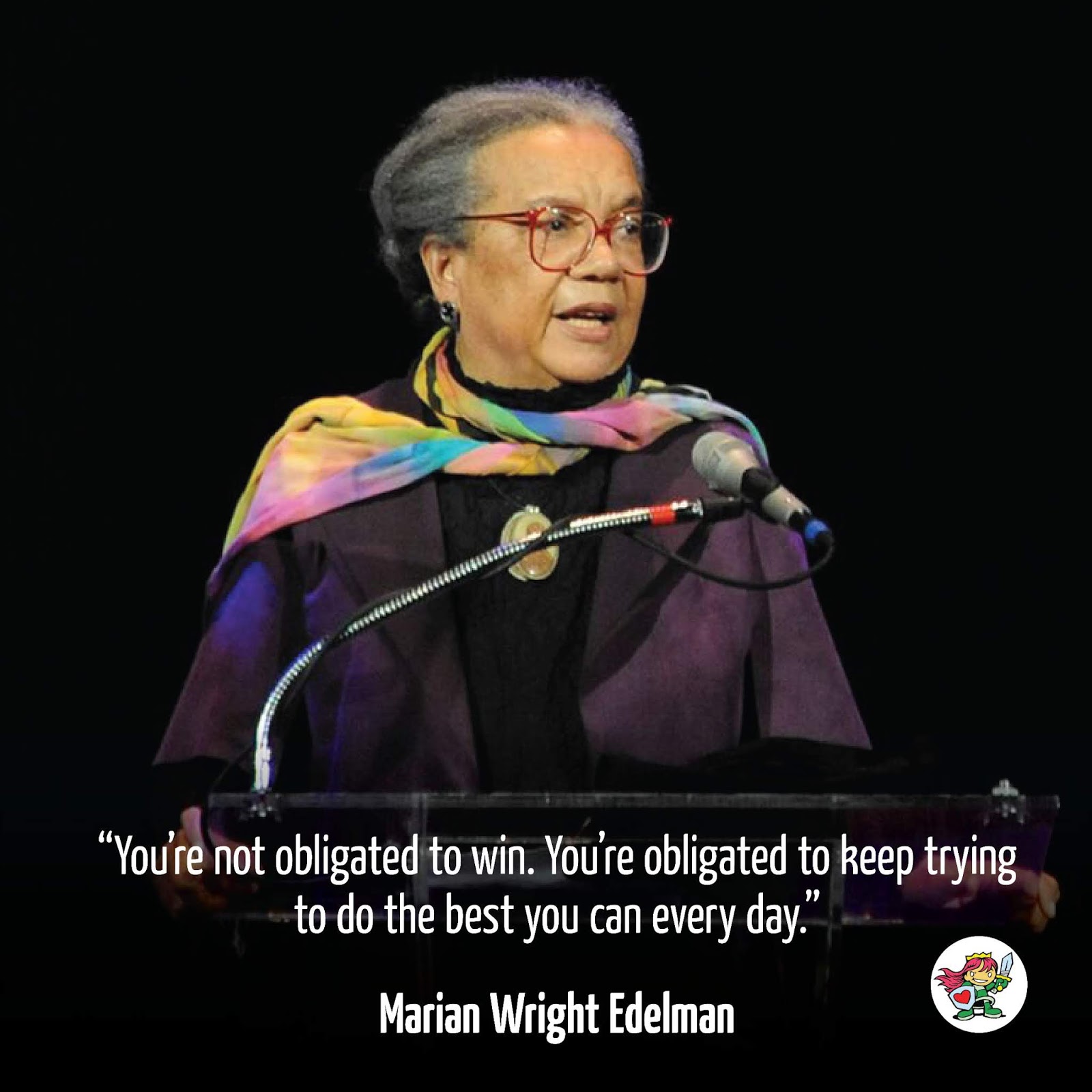
Marian Wright Edelman and trying your best

I've been thinking about what inspires social justice activists to continue fighting when it feels like there's always more work to do. One of the women whose work continues to inspire me is Marian Wright Edelman.
"You’re not obligated to win. You’re obligated to keep trying to do the best you can every day." Marian Wright Edelman
The more I learn about her life and her work, the most I admire her. This quote is one I refer to often when I'm feeling discouraged. She has dedicated her life to protecting children, and especially children from disadvantaged backgrounds, and has helped improve the lives of millions. But there is still so much work to be done, and if anyone would know about how to stay focused and to keep doing their best every day in the face of daunting odds, it's Marian Wright Edelman.


Where does her strength come from?
While she was growing up, her father, a minister, would say "God runs a full employment economy." Her parents lived by the philosophy that whenever they saw a need, it was their responsibility to try to fill it, and guided their children to do the same. They were taught to be "servant-leaders," using their service as a way to improve the world around them. She was only 14 when her father died. His last words to her were "Don't let anything get in the way of your education." Such a heavy mantle to lay on a child, but she carried with grace and an incredible inner strength that came from knowing she was given the great gifts of intelligence and determination. She had already been told that she was powerful and capable, and that the best way for her to serve would be to make the most of her opportunities in service of the greater good.

She didn't let him down. She graduated as valedictorian from Spelman College in 1960, and studied law at Yale Law School, graduating with her JD in 1963. It was in her senior year at Spelman College that she joined the Civil Rights Movement, and was arrested as part of one of the largest student sit-ins at the Atlanta City Hall.

Becoming a servant-leader.
After she graduated from Yale Law School, she immediately headed directly to the center of the Civil Rights Movement activities: Mississippi. She worked as a lawyer for the NAACP Legal Defense And Educational Fund out of their Mississippi office, and became the first African American woman admitted to the Mississippi Bar. It was the Freedom Summer of 1964, and she was right there in the middle of it all, representing activists, working on racial justice issues, and witnessing first-hand the horrors Jim Crow and the tragedy of grinding poverty.

It was the experience of seeing children dying from preventable diseases, starvation, and generalized poverty that changed the course of her life. While still in Mississippi, she was instrumental in establishing the Head Start program there. Created under President Johnson's War on Poverty, the goal was to give communities the help they needed to meet the needs of disadvantaged preschool children, giving them a "head start" to prepare them for elementary school.

Using her voice.
Still fired up by her experience in Mississippi, she moved to Washington, DC, where she founded the Washington Research Project, a public interest law firm focused on civil rights and racial justice. But her real focus was serving the needs of children. She founded the Children's Defense Fund as a voice for those who cannot speak for themselves, particularly poor children, children of color and those with disabilities.

For 45 years she served as president of the CDF, using her position to tirelessly advocate for children across the country, taking on critical issues as diverse as child poverty, child health, youth justice, teen pregnancy, and gun violence. The CDF has been at the forefront of nearly every piece of legislation affecting children in the United States.

In November 2018, Marian transitioned from president to the role of president emerita, stepping back from the day to day duties. I guess that's as close to retirement a "servant leader" will get. As she said in a recent TED interview, "I feel like the luckiest person of the world to have been born at the intersection of great needs and great injustices and great opportunities to change them. I just feel very grateful that I could serve and make a difference."

My inspiration to keep telling the stories of remarkable women comes from your support! If you were inspired by what you've read here, please consider making a donation, and share this post with your friends.


You may also be interested in:

Read This: Claudette Colvin: Twice Toward Freedom
"I'd had enough of just feeling angry... I was tired of hoping for justice. When my moment came, I was ready." Her moment came on March 2, 1955, when she was arrested for refusing to give up her seat on the bus. A full nine months before Rosa Parks did the same. In many ways, I find the story of this brave teenager to be even more inspirational than Rosa Park's.
Lorraine Hansberry - Eternally Young, Gifted and Black
"A woman who is willing to be herself and pursue her own potential runs not so much the risk of loneliness, as the challenge of exposure to more interesting men - and people in general." Lorraine Hansberry knew what she was talking about. She never shied away from pursuing her own goals.
Uncovering Stories: Raye Montague - Navy Engineer
She was promoted into a civilian position with the equivalent rank as a captain, working as the Program Manager of Ships, in charge of the entire process of building a ship -- a dream job that combined her engineering talents with her business degree. She was the first woman to earn that position and she took it very seriously.

Monday, May 7, 2018

Science Fair Rock Stars: Mikayla Sharrieff, India Skinner, and Bria Snell

High school juniors Mikayla Sharrieff, India Skinner, and Bria Snell have been in the news quite a bit in the last week, but the articles have only barely touched on what I consider to be the really exciting part of their story: these smart girls came up with an inexpensive and easy way to filter lead out of drinking water! And not only lead, but other impurities and bacteria like e. coli.


Their creative system builds on NASA Spinoff technology using specially created filtering floss made from nanofibers. A spinning fan circulates the contaminated water through the floss, which traps the unwanted particles. The clean water is then transferred to the storage container.

Their project "From H2NO to H2O" earned them a spot in the finals of the 2018 NASA Transformers Optimus Prime Spinoff Promotion and Research Challenge (OPSPARC) contest, which was created to encourage students to come up with creative uses for existing NASA technology in projects that would benefit the general public. Mikayla, India, Bria decided to turn their attention to the problem of lead-contamination in school water fountains.

Tragically, contaminated drinking water is an everyday issue for far too many students around the country, and one that hits home for these three burgeoning scientists: their school, Benjamin Banneker High School in Washington, DC, has several drinking fountains that have been taken out of commission because of concerns regarding lead contamination.

They took their idea to their mentors at the Inclusive Innovation Incubator, a technology incubator whose mission is to support entrepreneurs and businesses from underrepresented communities that provide products and services benefiting under-served communities, who gave them the encouragement and guidance they needed while building their prototype for the NASA OPSPARC contest. Their mentors' confidence is well-placed. This team of resourceful young women are the only all-black, all-female team to make it to the finals.

The winning team will be announced later this month. Winners will be invited to NASA's Goddard Space Flight Center for a two-day workshop, and a $4000 stipend to cover their expenses for the trip. But these girls are already winners! They've caught the attention of celebrities and politicians alike. The Washington, DC, mayor Muriel E. Bowser has pledged a $4000 award to help the girls continue work on their filtration system.

Not only are these young women looking at careers in STEM, they're already looking for ways to inspire others. As Mikayla, who is looking at becoming a biomedical engineer, put it, "It’s important to be role models for a younger generation who want to be in the STEM field but don’t think they can." India, who wants to be a pediatric surgeon, wants to make sure others see their full potential, to "see our faces, and see we’re just regular girls, and we want to be scientists."

If you appreciate the work I do here on SRPS, please support me!

Thursday, February 22, 2018

Joyita Mondal - trans trailblazer

In July 2017, Joyita Mondal was appointed as a judge on a Lok Adalat (a type of civil court) in West Bengal, India, making her the first transgender person to serve in such a role in that country. This comes after years of hard work fighting for the rights of the LGBT community, as well as for the rights of other marginalized communities -- the elderly, the disabled, and anyone else facing discrimination.


She didn't set out to become an activist. When she left home, she was simply trying to escape the oppressive environment of her small Hindu community, where she faced bullying by her peers and had few opportunities to live life on her own terms. She dropped out of school and moved to Islampur, a small city in the Uttar Dinajpur region, where, although she was able to find some work as a dancer in wedding ceremonies, she still had trouble finding a safe place to live and was often forced to beg for money to survive.

But she began to meet other transpeople, and after talking to them she founded her activist organization, 'Dinajpur Notun Alo Society' (Notun Alo means "new light") to help address some of their needs. "I started counseling sessions in hopes of reducing stigma by inviting relatives and family members of transgender persons. We showed films on the problems faced by the community. Further, sensitization of teachers and students in government and private schools and colleges started, and street plays at bus stands and other popular spaces were performed." She also began taking correspondence classes, and eventually earned a degree in law.

Her organization began looking for ways to assist other marginalized groups, and extend their outreach efforts beyond LGBT issues. "When I came to Islampur around nine years ago, my job was restricted to working for the rights and development of the transgender and LGBT community. But as I slowly progressed and got in touch with district administration officials, I felt the urge to work for all people and not just [the trans] community."

They began by addressing the needs of sex workers in local brothels, helping them register to vote and obtain identity cards, as well as locating services to help them with food and lodging. Then they began talking with the elderly members of their community. "We visited every house in the area for six months and shortlisted around 200 needy elderly people. We have submitted a proposal to the government for the construction of shelter home for elderly people."

Her work caught the attention of Judge Subroto Pole who appointed her as a Lok Adalat judge last year. Through her dedication to improving the lives of others, she has also made a huge change in her own life. "It gives me great satisfaction to know I have broken gender stereotypes. It is also gratifying to see those who once taunted me about my gender, stand before me with folded hands waiting for a judgment on their case."

For more reading:

Women's eNews "Meet the First Transgender Judge in India"

She The People "Meet Joyita Mondal, India’s First Transgender Lok Adalat Judge"

I can't do the work of SRPS without your your support!
If you like what you read, please share this post with your friends.

Monday, January 15, 2018

Abby Kelley Foster - radical woman

Abby Kelley Foster (January 15, 1811 – January 14, 1887) was an "ultra" abolitionist and feminist who withstood all manner of abuse in order to continue speaking out against injustice, and out-agitated many of the men and women we herald as leaders of the era.

"All the great family of mankind are bound up in one bundle. When we aim a blow at our neighbor’s rights our own are by the same blow destroyed. Can we look upon the wrongs of millions—can we see their flow of tears and grief and blood, and not feel our hearts drawn out in sympathy?"


Abby Kelley was born to Quaker farmers, but even from an early age she was aware of the inequality in how she was treated when compared to the boys she grew up with. As a young adult, she expanded her radial beliefs when she heard prominent anti-slavery advocate William Lloyd Garrison speak. She quit her position as a teach and immediately joined the Female Anti-Slavery Society, where she quickly earned herself the respect of many of her companions. She was elected to serve on a committee whose duty was to circulate petitions to gather support before they were to be sent to the federal government. In short order, she'd gained the support, and signatures, of half the women in town.

But she wasn't content to simply gather signatures. She was called to speak, even though there were strong social prohibitions against women speaking in public. Undaunted, she braved a torrent of abuse in order to make herself heard. She was routinely castigated in the press for her behavior, was at least once forcibly removed from a meeting of Orthodox Quakers because she refused to stop speaking, was regularly pelted with eggs and rotten produce (and worse), and was often forced to give her speeches in the outdoors because she was barred from speaking at organized events.

No matter. Instead of shutting her up, all that she endured simply worked to make her even more revolutionary in her beliefs. She began advocating for true equality between the races and between the genders. She influenced feminist foremothers like Susan B. Anthony, and then called them out when they refused to support the 15th amendment. Her work in Seneca Falls during the early abolitionist meetings set the foundation for the women's rights conventions that came afterward.

Her radicalism was applied to all aspects of her life. She was a strong proponent of "come-outerism" -- the idea that abolitionists could not stay in churches that did not condemn slavery. She encouraged anti-slavery activists to call out their churches and confront any clergy who did not forcefully stand on the side of abolition, and in every town where she spoke, she made it a point to publicly question their church leaders.

She married another radical abolitionist, Stephen Foster, and when they weren't busy traveling the country together speaking on the abolitionist and feminist speaking circuit, they worked on the farm they purchased, which they named "Liberty Farm." It was here where they raised their daughter Paulina, although Abby only took a few years off from organizing and speaking engagements. Contrary to the domestic ideal being pushed on middle class white women of the era, she was adamant that women could be mothers and wives and still have an active life outside the home.

Frederick Douglass wrote of Abby, "Her youth and simple Quaker beauty, combined with her wonderful earnestness, her large knowledge and great logical power bore down all opposition wherever she spoke, though she was pelted with foul eggs and no less foul words from the noisy mobs which attended us."


For further reading:

National Abolition Hall of Fame and Museum: Abby Kelly Foster bio

Civil War Women: Abby Kelley post

New England Historical Society: "Abby Kelley Shakes Up Seneca Falls"

Ahead of Her Time: Abby Kelley and the Politics of Antislavery by Dorothy Sterling (Amazon)

I can't do the work of SRPS without your your support!
If you like what you read here, please share this post with your friends.

Tuesday, January 2, 2018

Kate Shelley and the Midnight Express

Kate Shelley and the Midnight Express
by Margaret K. Wetterer, illustrated by Karen Ritz

What would you do if disaster struck one rainy, dark evening? Fifteen-year-old Kate Shelley grabbed a hat and a heavy coat and ran out into the dark and wet to help in any way she could.
Kate stared at the rickety wooden bridge. There were boards loose on its narrow walkway. There was no railing to hold on to. She was afraid to cross this bridge even in daylight. But she had to cross it now. She had to get to the train station in time to stop the midnight express. 
Margaret Wetterer tells the story of this brave young woman as she fights against the elements as well as her own fears to save the lives of unsuspecting travelers on the midnight express train headed at full speed toward the bridge that was washed out during a torrential downpour. The illustrations by Karen Ritz capture the thrilling journey Kate made in the dark across a dangerous bridge high above a raging river as she desperately tries to reach the train station in time to have them stop the coming train.

Kate Shelley and the Midnight Express (Amazon / Library) earns the Self-Rescuing Princess Society seal of approval for sharing the story of a young woman who lost a father and younger brother in tragic accidents and who, when faced with danger, didn't shy away from trying to help save others. Margaret Wetterer's ability to convey the excitement and bravery of this story in such simple language is remarkable, making it an excellent book for early readers.

[Note: I have included Amazon Affiliate links in this post. I am exploring options for increasing my income from this blog to help me to continue to bring you the important stories of kickass women and girls. While I will always work to tell these stories, I have bills to pay. By all means feel free to look for these books elsewhere if you prefer. If you want to help support the work I do here, please consider using these links to shop.]

I can't do the work of SRPS without your your support!
If you like what you read, please share this post with your friends.

Wednesday, August 16, 2017

Badass Women Who Fought Nazis

The mission of the Self-Rescuing Princess Society is, as I'm sure you have already figured out, to share stories of women and girls who have done or are doing good things in the world. Obviously, what constitutes "good things" is completely subjective, and this seems like an excellent time to make it absolutely clear what that means for this blog. Doing good things includes, but is not limited to: promoting fairness and equality for marginalized groups, using one's talents to improve the world, protecting herself and others against harm, challenging the institutions that support racism, misogyny, colonialism, etc., and pretty much anything else that would get someone labeled as a "social justice warrior."


This includes fighting Nazis. In fact, over the last few years, I've written several posts about women who bravely fought against the original Nazis during World War II. For them, it wasn't simply a matter of going to a protest on a sunny Saturday afternoon. Fighting Nazis was a day-in-day-out, life or death struggle, and some of them gave their lives for the cause.

Below is a list of these brave Nazi-fighting women, with a link to the posts where you can read more about them, their lives, and their bravery. You can be sure I will continue to write about other women who fought alongside them, as well as women from other parts of the world, and other eras, who have shown the same kind of strength and resolve in the face of tyranny and oppression. By reading their stories, we can find inspiration to continue our own mission for social justice for all.

Regina Jonas - the first woman rabbi
In 1935, Regina Jonas became the first woman to be ordained as a rabbi. She had been orphaned as a young girl in Berlin, and originally pursued a career as a teacher. But wanted more for her life, so she enrolled in seminary classes, with the intention of becoming a rabbi, even though no other woman before her had been ordained. On December 27, 1935, liberal Rabbi Max Dienemann, granted her ordination, just as the Nazis were beginning their rise to power.

She was never able to serve as a the rabbi in a synagogue, sadly. Before she could find a congregation, she was sent to a concentration camp with other Jews. Even there, she continued her work as a rabbi, ministering to the other prisoners, helping them cope with shock and disorientation. She worked there until mid-October of 1944, when she was deported to Auschwitz, where she was murdered two months later. She was 42 years old.

Sigrid Schultz - the dragon from Chicago
Sigrid Schultz was an American war correspondent for the Chicago Tribune whose European upbringing enabled her to mingle with high-ranking German officials without attracting attention, giving her plenty of opportunity share the truth of what was happening in Germany during the 1930s with the rest of the world. This put her at considerable risk and she often had to resort to writing under a pseudonym and filing her reports under false datelines out of other European offices.

She stayed in Germany for as long as she could, filing reports about concentration camps, government assaults on churches and other institutions, telling the truth about increasing persecution of Germany's Jews, warning about dangerous alliances with other countries, and otherwise trying to convince the world of the atrocities she was witnessing.

Malka Zdrojewicz - Jewish resistance fighter
By 1943, Jews throughout Europe were well aware of the incredible danger they faced. Everyone in the Warsaw Ghetto had been forcibly moved there -- often after they'd already escaped the Nazis as they passed through rural villages in eastern Poland on their way to the Russian front -- and they knew that it was only a temporary arrangement as the Nazis figured out what to do with them. They'd already seen large groups of their friends and family members taken away to Treblinka and Majdanek, two of the Nazi German Extermination camps in Poland.

Malka Zdrojewicz, along fellow resistance fighters Rachela and Bluma Wyszogrodzki, was arrested by the SS for having carried arms (guns and grenades, etc.) into the Warsaw ghetto. These brave young women risked their life as part of their active resistance of Nazi oppression.

Astrid Løken - fearless scientist and spy
Most of the people who worked with Astrid Løken never suspected she was a high ranking member of the Norwegian resistance movement during World War II. They only knew of her passion about bumblebees and her dedication to her research.

Shortly after the Nazi forces invaded Norway in 1940, the resistance force known as XU began recruiting researchers in natural science, realizing their field work would give excellent cover for their spy work. Astrid applied to the Nazi authority for permission to study bumblebees near otherwise restricted military areas. Because they assumed she was a harmless scientist watching insects, she was given free range, and routinely took photos of roads, bridges and other important structures, which she then developed back at the university where she was studying.

Lyudmila Pavlichenko - badass with a gun
It's all well and good to punch Nazis, but Lyudmila Pavlichenko did more than that. She shot them. And not just a few. As a USSR Army soldier in World War II she sniped 309 of them.

When she showed up at the recruitment office after the Germans invaded the USSR, she was initially offered a job as a nurse, but they agreed to let her prove herself. They handed her a rifle and showed her a couple of enemy fighters across the field of battle. She convinced them by handily dispatching both, earning her place as a sniper. In fact, there were over 2,000 female snipers in the Soviet Army. But Pavlichenko was the best. Her successes in the field earned her the respect of her superiors and the admiration of civilians near and far.

Leona Woods - visionary scientist
Not all of the Nazi-fighting occurred in Europe. Thousands of Americans worked tirelessly on stateside projects that helped support the soldiers and spies overseas. The scientists involved with the Manhattan Project worked day and night trying to beat the Germans to construct the first nuclear bomb. Leona Woods was the only female physicists on the team that built the world's first nuclear reactor, which helped the scientists in Los Alamos solve the puzzle of how to turn atomic energy into a weapon.

She knew that her work was most than just a science experiment. It was a desperate race to beat the Germans who would surely use such a weapon to expand their fascist goal of creating a new world order.

Irena Iłłakowicz - Polish resistance martyr
In September 1939, within 3 weeks, both the Germans and Soviets invaded Poland. In October, Irena joined the resistance movement with her husband. Irena was assigned to a branch responsible for conducting military, economic and information reconnaissance, and sent to Berlin to spy on the Germans.

When her network was discovered by the Germans, dozens of activists were arrested. Irena herself was arrested and taken to Pawiak, a prison that was being used to interrogate resistance members, and to process Jews and others for removal to concentration camps, where was tortured. She bravely refused to give up any info despite increased torture. Her resistance colleagues, hoping to spare her, sent her a vial of cyanide, but she refused to use it. She was eventually able to escape, after her husband bribe a guard and other resistance members forged documents to have her released.

Margaret Bourke-White - inspirational photojournalist
In 1936, talented photographer Margaret Bourke-White was hired by the publishers behind a brand new magazine, Life, where her work was a regular feature, creating a new job as a photojournalist. She continued traveling to cover important events around the world. When World War II broke out, she was already on the ground in Europe, making her the first woman allowed in combat zones there. When German forces invaded Moscow, she was the only foreign photographer there, making her images a valuable resource documenting the firefight.

When the US entered the war, she found a spot with troops in North Africa, Italy, and Germany. She was there to captured the gruesome scenes when the Buchenwald concentration camp was liberated, the first time these types of horrors were so clearly illustrated for the American public.

Josephine Baker - World War II spy
Internationally acclaimed singer and dancer Josephine Baker moved France in the mid-1920s to escape the soul-crushing racism she experienced in the United States. When the Germans invaded Poland, she refused to leave France for safer areas, and instead joined French Resistance when she was recruited by the French military intelligence to serve as a "honorable correspondent." Her role was to use her celebrity to mix with high-ranking officials at embassy parties, and gather information about troop locations. She moved freely all around Europe, Northern Africa, and even South America as an entertainer, carrying info about airfields, harbors, and troop concentrations back to officials in France or Britain written in invisible ink on her sheet music.

For her efforts, she was awarded the honorary rank of lieutenant in the Free French Air Force, and after the war she received both the Croix de Guerre and the Medal of the Resistance, and was made a Chevalier of the Légion d'Honneur, an honor usually reserved for French citizens.

Katya Budanova - brave young role model
Katya Budanova was born into a peasant family in rural western Russia. After the death of her father she was sent her to live with her sister in Moscow. It was there, working as a carpenter in an aircraft factory, where she began to show an interest in flying. The factory had an aeroclub, and Katya, always the brave one, joined the parachute team. In 1934, at the age 18, she earned her flying license, and in 1937, she graduated to flight instructor.

When Hitler's forces attacked the USSR, like many of her compatriots, she rushed to enlist in the military. She was assigned to the all-female 586th Fighter Regiment, led by the infamous Marina Raskova. With the war raging all along the western border, her regiment was called in to take the place of male fighters. Katya flew her first combat missions in May 1942, defending the rail-lines near Saratov. Over the course of the next year, Katya showed extreme bravery and skill, defending her country by shooting down enemy planes of all types, earning the Order of the Red Star, the Order of the Patriotic War, and the title of Hero of the Russian Federation (posthumously).

I can't do the work of SRPS without your your support!
If you like what you read here, please share this post with your friends.

Monday, July 31, 2017

SRPS Role Model: Dr. Fannie Emanuel

I love sharing stories of women pursuing their dreams, as you probably already know. It's kinda my thing. It's particularly important, though, to celebrate older women who take up a new and challenging goal in mid-life or later. We have too few role models for this age group, so when I come across stories of amazing older women I am extra excited to share them with you.

After working nearly 20 years as treasurer for her husband's business, Fannie Emanuel (July 31, 1871 – March 31, 1934) went looking for more ways to help her community in Chicago. She began taking college courses in social sciences, and possibly thinking about studying medicine. In 1908 she decided to put into action the concepts she was learning in her classes, and established the Emanuel House, a settlement house with the mission "to inspire higher ideals of manhood and womanhood, to purify the social condition, and to encourage thrift and neighborhood pride, and good citizenship."

Settlement houses were private organizations focused on improving the communities they served by offering a wide range of services. Emanuel House addressed the disparity in educational opportunities for the children in the poor, predominately black neighborhood by offering kindergarten classes and a boys' and girls' club. Mothers could take classes in cooking, sewing, or domestic science, as well as attend regular mother's meetings. Emanuel House also hosted a free dental clinic and an employment bureau.

The part of Fanny Emanuel's story I find inspiring is she never stopped reaching for more. In 1911, at the age of 40, she made the decision to pursue a medical degree. When she enrolled in classes at the Chicago Hospital College of Medicine her two adult sons were also earning their own college degrees. Here was a woman who worked helping her husband's business while raising a family and staying active her community who, instead of resting in the comfort she'd earned, set out to do more.

While operating her private practice in Chicago, and between family trips to her summer cabin in northern Michigan, Dr. Emanuel continued her social work with important community organizations. She gave her time, energy, and business expertise to groups addressing the needs of the black community, such as the WYCA, Ida B. Wells Women's Club, and Delta Theta sorority, as well as serving on the Board of Directors for the Phyllis Wheatley Club (named after Phyllis Wheatley, a slave poet who lived from 1753 to 1784), an institution serving African American women, often providing lodging for younger women as well as retirement homes for older or disabled or sick women.

Dr. Fannie Emanuel was a woman who never stopped working to improve the lives of her neighbors, and when given an opportunity to follow her dreams she took it, and for that she's most certainly a Self-Rescuing Princess Society role model.

I can't do the work of SRPS without your your support!
If you like what you read here, please share this post with your friends.

Thursday, June 22, 2017

SRPS Inspiration: Life Lessons from Octavia Butler

I've been thinking about Octavia Butler quite a bit lately. I hate to admit I haven't read much of writing, but I've been reading about her and finding more than enough inspiration from her life and struggles as an African American woman trying to find a place in the (still too) white male dominated field of science fiction.

She credits her perseverance for helping her overcome the challenge of trying to be a writer compounded by being an outsider. From a young age she had to navigate through the physical world where people like her -- female and black -- were told not to aim too high, and then find a place in a fictional world where people like her didn't exist. But she persisted, and through her struggles was able to tell stories that took the entire genre of science fiction to an entirely new level by showing us the complexities of humanity and how we are all connected while at the same we are limited by our perspective.

By reading about her struggles and successes, and what she learned from them, we can find guidance for our own lives and inspiration to continue pushing forward.

1. Allow yourself to dream and then get to work.
"We're all capable of climbing so much higher than we usually permit ourselves to suppose."
Fear of failure as well as fear of success can hold us back from pushing ourselves to find our upper limit. I see this in my own life when I'm afraid to follow through on an idea, afraid that it would be seen as silly, or a waste of time. Well, in a way it IS silly to think that following an idea would be a waste of time. No one was ever successful by just staying where they started.

Octavia knew she wanted to be a writer. She wanted her books read by millions of people. She allowed herself to dream of success. But she didn't just dream it into being, she did the long, hard work of making it happen. She wrestled with the uncertainty and fought writer's block and still sat down at the typewriter every day to create the books she had inside her.


2. Do the right thing. Always.
"I have a huge and savage conscience that won't let me get away with things."
Her father died when she was seven, leaving her mother to raise her with the help of her own mother. Together, her mother and grandmother impressed on Octavia the importance of character and following one's conscience. She said, later, that growing up in this strict Baptist home helped to build her adult morality.

This didn't just mean not stealing or telling the truth. It was her conscience that made her keep working even when it was difficult, and to then turn her success into a means to help pull others up the ladder behind her. She used her experience as a writer to help other aspiring authors, and especially writers of color. Even though she was a renowned recluse, she returned several times to the Clarion Writer's Workshop -- the same annual workshop she had attended during her early years -- to advise other struggling writers.

After her sudden death at age 58, an annual scholarship was set up to help writers of color attend the Clarion workshop, fulfilling a promise she'd made to herself to "send poor black youngsters to Clarion or other writer's workshops."


3. Find a way to be yourself.
"I began writing about power because I had so little."
Like others who are painfully shy in school, and often bullied because of it, she found comfort in books. She was particularly drawn to science fiction. She kept a notebook she filled with her own stories. When she was 10 her mother bought her a typewriter. In 1954, when she was 12, she watched Devil Girl from Mars, and decided she could write a better version. So she did. This early attempt was the template for what eventually became her Patternist series.

As a young black girl living in the 1950s, she had to find a way to be more than what society told her she was. Even if it was just on the pages in her stories, and in the dreams she had of herself. By carving out this space for the inner young Octavia, she fed the fire that lead her to become the adult Octavia, full of determination and perseverance.


4. Don't let anyone say you can't.
"No one was going to stop me from writing and no one had to really guide me towards science fiction. It was natural, really, that I would take that interest."
When she was 13, her aunt, probably more out of kindness than anything else, told Octavia that "Negroes can't be writers." Her aunt, of course, knew a bit more about the world and how it treated African Americans who try to step outside the accepted roles, and thought she was helping Octavia be more realistic in her career goals. But Octavia wasn't having it. She kept on writing, and by the time she was in high school, she submitted her first manuscript to a science fiction magazine.

Thankfully while her aunt was trying to advise her to lower her expectations, her mother was busy helping to raise them. It was her mother who encouraged her to write, who scrimped to buy her a typewriter on a housekeeper's salary, and who gave up her savings for much-needed dental work to help Octavia travel to the Clarion workshop that changed the course of her writing.


5. Representation matters. So does context.
"When I began writing science fiction, when I began reading, heck, I wasn't in any of this stuff I read. The only black people you found were occasional characters or characters who were so feeble-witted that they couldn't manage anything, anyway. I wrote myself in, since I'm me and I'm here and I'm writing."
In college Octavia won a college-wide writing contest, her first taste of success. This was also around the time the preliminary idea for Kindred came to her. It was the late-60s, and a fellow African American student railed against what he saw a passivity in previous generations of African Americans when confronted with injustice. Octavia knew the past was more complicated and dangerous, and wanted to find a way to place their actions into historical context. She wanted to show that what may look like passivity and subservience to the modern generation, was a kind of silent strength needed for survival.

She talked with her older relatives about their experiences as maids and gardeners, and listened to their stories of how it was "back then" and found a greater understanding of how they were able to survive by staying silent in the face of adversity, while also planting the seeds for future change. Her mother had to work as a maid, enduring the humiliation of going into the homes of wealthy white people through the backdoor, to pay for Octavia's education and support her dreams of adding her own voice to the stories. And in doing so, Octavia was also able to give voice to the silent generations before her.


6. You have to do the hard work.
"You don't start out writing good stuff. You start out writing crap and thinking it's good stuff, and then gradually you get better at it. That's why I say one of the most valuable traits is persistence."
After college, she continued to write, taking part time and temporary menial jobs to pay for her small apartment and provide her with the time to write. But she hadn't quite found her voice yet. Her stories were patterned after the writing of white male science fiction authors she'd been reading and didn't accurately reflect her own experiences.

It took nearly a decade, and hundreds of rejection slips, for her to finally work through her early tendency to write like establish authors and find her own style. By the mid-1970s she was working on the novels that would become the Patternist series, and by 1978 she was finally able to support herself with her writing.

That's ten years of getting up each morning at 2 am to sit at the typewriter and write. Even when the words wouldn't come, or the ideas weren't inspiring. Even when she'd rather stay in bed or watch tv, or do pretty much anything other than sit there. Even when she was nearly convinced that everything was trash and she should just give up. She still got up in the dark, and got to work.

I can't do the work of SRPS without your your support!
If you enjoy what you read here, please consider making a donation.

Wednesday, June 14, 2017

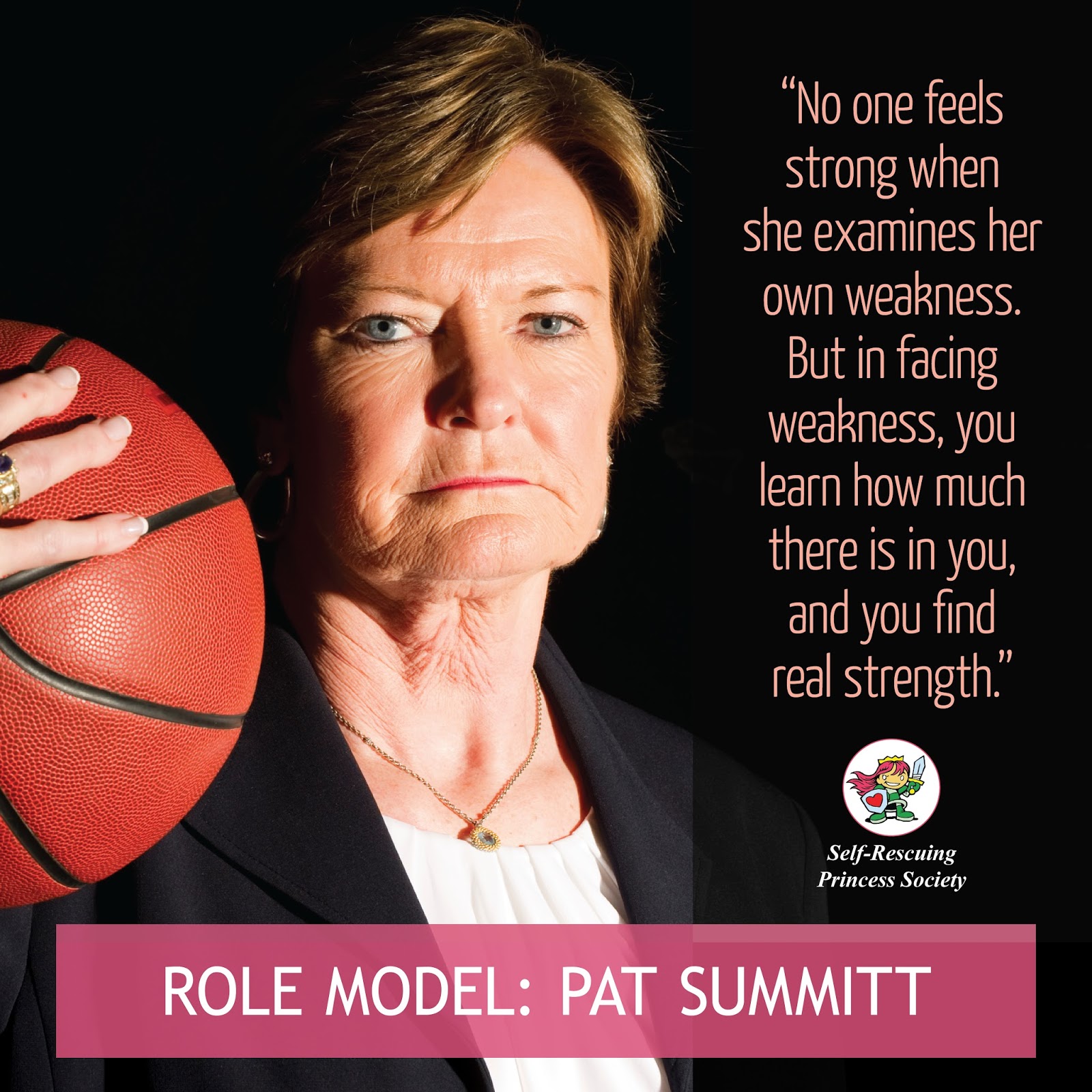
SRPS Role Model: Pat Summitt - basketball icon

Pat Summitt (June 14, 1952 – June 28, 2016) is best known as the inspirational basketball coach with a record-setting 1098 career wins, but how much do you know about her life and how her basketball career highlights the changing climate for women in sports?


Pat was born in Clarksville, Tennessee, into a family filled with sports fans and athletes. When she was in high school, her parents moved to a nearby town just so she could play basketball. This was years before Title IX, and her hometown school didn't offer a girls team.

When she enrolled in the University of Tennessee at Martin, she didn't receive an athletic scholarship like her brothers did, because colleges didn't have to offer parity in sports funding and scholarships. And still, she won All-American honors. And I have to wonder what role her college coach, Nadine Gearin, the woman who founded the UT-Martin women's team, played in Pat's career choice?

After graduating from UT-Martin, Pat took a position as a graduate assistant at the University of Tennessee (Knoxville), where she was also appointed as the new head coach of the women's basketball team, the Lady Vols, to replace the previous coach who quit abruptly. This was certainly a fortuitous turn of events for both Pat and UT. Her first season with the team, 1974-75, they won their district championship, setting a precedent that would define her career.

The next year, while still coaching another winning team, she was also earning her master's degree in physical education AND training as co-captain for the 1976 Women's Olympic team. They won the silver medal in the first-ever Olympic women's basketball competition.

She and her Lady Vols went on to have 38 winning seasons. In fact, she never had a losing season in her long coaching career. And when she coached the US Women's Team in the 1984 Olympics she took home a gold medal to go next to her silver.

When she retired, she had won eight NCAA championships, a NCAA women's record, with an astonishing 1,098 wins, the most in the entire NCAA history. I'm sure it's no surprise that she's an SRPS Role Model. This woman who had to chase her dream of playing basketball at a time when women's sports weren't taken seriously, went on to have a serious impact on women's sports by coaching some of the world's best players and bringing world-wide attention to women's basketball.

You can read more about her coaching career in this 1998 Sports Illustrated article "Eyes Of The Storm."

I can't do the work of SRPS without your your support!
If you like what you read here, please share this post with your friends.

Wednesday, June 7, 2017

SRPS Role Model: Nikki Giovanni

Nikki Giovanni (born June 7, 1943)
"Deal with yourself as a individual, worthy of respect and make everyone else deal with you the same way."
Today is the 74th birthday of American poet, writer, commentator, activist, and educator Nikki Giovanni.

She is considered one of the world's most well-known African-American poets, and often called the "Poet of the Black Revolution" because of her strong, often militant, response to current events. Growing up during the Civil Rights Movement of the 50s and 60s, she came of age during the burgeoning Black Power Movement, and her work is a frank expression of her frustrations with the state of race relations around the world, as told from an African American perspective. Her first volume of poetry was a response to the civil unrest of the late 1960s after the assassinations of Martin Luther King, Jr. and Malcolm X.


"Since no one wanted to publish me I formed a company and published myself."

As much as her work was critically acclaimed, she still had trouble finding publishers to take her on, so in the early 1970s she founded her own publishing company, NikTom Ltd., with the mission to provide publishing opportunities for other African American women as well, including Gwendolyn Brooks (who shares the same birthday!).

After the birth of her son, she expanded her writing to include children's books. In addition to poetry, she has also published several works of non-fiction addressing a wide range of social issues from racism to relationships, and even including works discussing the social importance of hip-hop.
"My dream was not to publish or to even be a writer: my dream was to discover something no one else had thought of. I guess that’s why I’m a poet. We put things together in ways no one else does."
Over the last 50 years, she has proven herself again and again as a leader for everyone who is working for a better, more equitable future. Through her work as a poet as well as her work for equality and justice, and her transition to serving as a committed elder guiding younger generations, she is the embodiment of the ideals of the Self-Rescuing Princess Society.

You can learn more about her life and work, as well as read many of her poems and articles in her Poetry Foundation entry.

If you found this post helpful, as well as the rest of what you read here,
please share it with your friends, and consider supporting me!

Wednesday, May 31, 2017

Chien-Shiung Wu - courageous hero and brilliant scientist

Who better to celebrate on the last day of Asian-American Pacific Islander Heritage month than Chien-Shiung Wu (May 31, 1912 – February 16, 1997), a Chinese-American experimental physicist who made significant contributions in the field of nuclear physics. She was born in a small town in China at a time when girls weren't sent to school, and yet she spent her entire life thinking about and solving complex problems in physics. Because of her absolute dedication to performing nearly perfect experiments and her reputation as a thorough and brilliant experimentalist, she quickly became known as the "Chinese Madame Curie," the "Queen of Nuclear Research," and the "First Lady of Physics."


She was set on her path to physics from an early age. Much of her love of learning and the study of physics, and her unrelenting determination, came from her father, who railed against the tradition in their region that prevented girls from attending school. In fact, he started his own school just so he could make sure girls in his area could attend. When she'd grown past what she could learn at her father's school, she was sent to a boarding school where she developed her life-long passion for mathematics, science, and especially physics. When she worried about being away from her family for so long at such a young age, her father told her to "Ignore the obstacles. Just put your head down and keep walking forward." Perhaps he knew she was destined for greatness when they named her Chien-Shiung, a name she translated as "Courageous Hero."
"I have always felt that in physics, and probably in other endeavors, too, you must have total commitment. It is not just a job, it is a way of life."
She didn't intend to move to the United States permanently.
Instead, she had planned a short tour before enrolling in the Ph.D. program at the University of Michigan. When she first arrived in San Francisco in 1936, she took a trip to Berkeley where she met pioneering American nuclear scientist and winner Ernest Lawrence, who was working on building the first cyclotron (for which he won a Nobel Prize in 1939), and that changed everything. She stayed at Berkeley for two years, working as a research assistant, and creating a name for herself as a brilliant experimental physicist.
"These were moments of exhilaration and ecstasy! A glimpse of this wonder can be the reward of a lifetime. Could it be that excitement and ennobling feelings like these have kept us scientists marching forward forever?"
Even as a research assistant she was provide valuable insight for well-established physicists.
Enrico Fermi, who would go on to create the world's first nuclear reactor, and his team was working on producing a large-scale, self-sustaining plutonium chain reaction, but their reactions would sputter out without explanation after running for a few hours. They were stumped, until someone suggested they ask Chien-Shiung Wu, who looked at their research notes and was able to determine that it was a problem with a buildup of xenon, which would trap the stray neutrons needed to keep the reaction going.
“You come in order to work and to find your way. You must work very hard at the beginning. It is hard to push the door open and to get inside a subject. But once you understand it, it is very interesting.”
She was one of the hundreds of female scientists working on the Manhattan Project.
She left Berkeley after getting married to fellow physicist Luke Yuan when he was offered a job at Princeton. At first, she took a job teaching young women at Smith College, but that position didn't offer any lab time, which she missed dearly. Since it was the early years of World War II, many positions were left empty at colleges around the country, and she was able to find an opening at Princeton. In fact, she was the first female professor there. That position led to her joining the Substitute Alloy Materials (SAM) Laboratories at Columbia University in 1944 as part of their work to support the Manhattan Project's efforts to beat the Germans in the race to build the world's first nuclear bomb. She commuted between Princeton and Columbia for the rest of the war.
"These are moments of exaltation and ecstasy. A glimpse of this wonder can be the reward of a lifetime."
After the war, she returned to her lab, and worked on solving problems for other physicists.
She found a critical flaw in experiments being performed to prove Fermi's Interaction -- Enrico Fermi's theory explaining the process of radioactive decay in which a beta ray (fast energetic electron or positron), and a neutrino are emitted from an atomic nucleus. Until she stepped in, no one had been able to duplicate anyone else's research findings, and thus the theory was still unproven. In her research into their methods she was able to deduce that the problem was a result of each experiment was using radiation sources of different thicknesses. She was able to control the thickness of her radiation sources, and prove once and for all that Fermi's theory was correct after all.
"Science is not static but is dynamic and ever-improving. It is the courage to doubt what has long been believed and the incessant search for verification and proof that pushes the wheels of science forward."
After that success, she barely paused before going and disproving a fundamental "law" of nature.
For nearly 40 years, physicists had treated the idea of conservation of parity as an absolute law, akin to the law of gravity. Conservation of parity held that when something happens in nature, it isn't random whether it happens in one direction or another -- left or right, so to speak -- but in both directions equally. When one of her colleagues suggested it might not be true, she took it upon herself to test it. By now she was working at Columbia full time, but in order to complete this experiment she had to travel back and forth between New York and Washington, D.C., where she worked with the Low Temperature Group of the US National Bureau of Standards. Her experiment required working with material at near zero Kelvin, the point at which all atomic movement ceases. She and her team worked tirelessly, carefully recording the decay of Cobalt-60 and tracking the gamma rays emitted to see whether they went left or right. If conservation of parity were true, there would be exactly the same number on each side. Two weeks later, they were able to conclusively report that conservation of parity was incorrect when they could prove that there were definitely more gamma rays emitted on one side than on the other.
"I sincerely doubt that any open-minded person really believes in the faulty notion that women have no intellectual capacity for science and technology."
She was a fierce advocate for women in science and engineering.
After she finally retired from the lab -- after even more impressive research -- she spent her time traveling the world to talk about her successes and about her experiences as a woman in a male-dominated field. She attended a symposium at MIT in 1964 to discuss issues around equality -- American Women in Science and Engineering -- where she joined other notable STEM women to speak to students from around the world, professors, deans and even high school guidance counselors.

What an amazing scientist and strong woman! She's certainly a Self-Rescuing Princess Society role model, for her remarkable work in the field of physics, plus her dedication to improving the representation of women in STEM fields back in the 1960s and 70s. And there was still so much more interesting things about her I want to share with you. Stay tuned!

If you found this post helpful, as well as the rest of what you read here,
please share it with your friends, and consider supporting me!


For further reading:

Scientific American article "Channeling Ada Lovelace: Chien-Shiung Wu, Courageous Hero of Physics"

Nobel Prize Women in Science: Their Lives, Struggles, and Momentous Discoveries, by Sharon Bertsch McGrayne (Amazon / Library)

A to Z of Women in Science and Math, by Lisa Yount (Amazon / Library)

Notable American Women: A Biographical Dictionary, Volume 5: Completing the Twentieth Century, edited by Susan Ware and Stacy Braukman (Amazon / Library)

The Madame Curie Complex: The Hidden History of Women in Science, by Julie Des Jardins (Amazon / Library)

Women of Science: Righting the Record, Edited by G. Kass-Simon and Patricia Farnes (Amazon / Library)


You may also be interested in:

Happy Birthday - Dr. Dorrit Hoffleit
During World War II, she went to work at the Aberdeen Proving Ground ballistics laboratory in Maryland. Not unlike many women working for the war effort, she was forced to take a position below her status while she watched men who had less experience take higher level jobs. Frustrated that women weren't getting the training they needed and the promotions they deserved...
Charlotte Moore Sitterly - Astrophysicist
This humble daughter of Quaker teachers went on to become one of the most important researchers in astronomy, with her works continuing to benefit science even now. As a student at Swathmore College, she took a wide range of classes to expose herself to as much knowledge as possible. When it came time to pick a major, though, she went with the department in which she'd taken the most classes, which was Mathematics. And it's lucky for us that she did.
Rebecca Lancefield - immunologist and microbiologist
Foremost in the countless scientists who have spent their lives improving the lives of others would be Dr. Rebecca Lancefield. Because of her life's work an immense number of different types of streptococci have been identified and studied, leading to better treatment of the often deadly diseases they cause, many of which were still a complete mystery to scientists at the beginning of the 20th century.