Kickass Women

History is filled with women doing all kinds of kickass stuff.

Smart Girls

Watch these girls... they're going places!

Inspiration

Need a dose of inspiration? Here you go.

SRPS Entertainment

Some of my entertainment recommendations with awesome female characters and stars.

She's Crafty!

Some of the awesome items made by kickass women!

Showing posts with label women in literature. Show all posts

Tuesday, September 12, 2017

María de Zayas - pioneering feminist writer

María de Zayas y Sotomayor (1590 – 1661) was a pioneering feminist writer during Spain's Golden Age of literature. She was the first Spanish woman to earn an international reputation as a writer, which lasted nearly 200 years, and used her stories to address feminist issues in Spanish society in the 17th century.


She was born in Madrid in 1590, probably a few days before her baptism which was recorded on September 12. It was the height of the Spanish Inquisition, a period of approximately 350 years of enforced Catholic orthodoxy where those deemed to be heretics were tortured and murdered, and others who fell afoul of the proscribed behavior risked fines or imprisonment. Women were expected to be subservient to their fathers and husbands, and aside from being a nun or a prostitute, their roles were limited to that of wives and mothers. Not surprisingly, this oppressive culture gave their fathers and husbands an inordinate amount of power over them.

As the daughter of an infantry captain, de Zayas was privileged in that she had enough wealth to afford to live somewhat on her own terms, and that provided her access to education and the freedom to write. She used her writing as a means to address the patriarchal system and how it bound women in often dangerous positions. In 1637, de Zayas published her first collection of novellas which told the stories of violence women experienced and illuminating their vulnerability in a society where this kind of brutality is acceptable. It was an instant hit and quickly spread across Spain and throughout Europe. Her second collection was published in 1647 and continued her mission to illustrate the challenges facing strong women.

It has been argued that de Zayas' female characters exist in within an interesting paradox. While they are all strong women, they are powerless to change the system. She was not telling the stories of the average woman, but instead of women with financial and intellectual means who were still unable to break down the societal forces against them and who then turned to using whatever small power they had to change their own circumstances. Certainly she must have realized it would be impossible for any one individual to change the entire social structure, especially with the power of the state and the church supporting it, but within the system each woman could fight for a measure of independence, and each man could address his own tendencies toward violence.

Her two collections remained immensely popular for nearly 200 years, and only fell into obscurity in the late-19th century when women's roles in society began to shift again. More emphasis was on the purity of womanhood, and critics' attitudes toward her work turned sour. Although you or I might think a review calling her work "the filthiest and most immodest that I have ever read" intriguing, readers of the 19th century did not.

It wasn't until the 1970s that her work again began to attract attention as the second wave feminist movement encouraged more interest in women authors of the Golden Age of Spanish literature. Since then there have been several excellent analyses of her work, as well as important study of its changing reception over the past 370 years. I have not read more than a few pages of a recent English translation, but I am certainly intrigued. In many ways her story reminds me of the experiences of Emilia Bessano Lanier, another female writer of that era. I only recently finished a new fictionalized biography of her life, and am beginning my own research into her work, which also addresses the experiences of women. (A review of that book is coming soon!) It would be interesting to compare the lives and works of each woman, and find the ways they may have influenced other women who came after them.

You can read her first collection Novelas Amorosas y Ejemplares online.

[Image: Mary Magdalene by Spanish painter José de Ribera, 1641]

I need your help to tell the stories of amazing women from history!
If you like what you read here, please share this post with your friends.

Thursday, June 22, 2017

SRPS Inspiration: Life Lessons from Octavia Butler

I've been thinking about Octavia Butler quite a bit lately. I hate to admit I haven't read much of writing, but I've been reading about her and finding more than enough inspiration from her life and struggles as an African American woman trying to find a place in the (still too) white male dominated field of science fiction.

She credits her perseverance for helping her overcome the challenge of trying to be a writer compounded by being an outsider. From a young age she had to navigate through the physical world where people like her -- female and black -- were told not to aim too high, and then find a place in a fictional world where people like her didn't exist. But she persisted, and through her struggles was able to tell stories that took the entire genre of science fiction to an entirely new level by showing us the complexities of humanity and how we are all connected while at the same we are limited by our perspective.

By reading about her struggles and successes, and what she learned from them, we can find guidance for our own lives and inspiration to continue pushing forward.

1. Allow yourself to dream and then get to work.
"We're all capable of climbing so much higher than we usually permit ourselves to suppose."
Fear of failure as well as fear of success can hold us back from pushing ourselves to find our upper limit. I see this in my own life when I'm afraid to follow through on an idea, afraid that it would be seen as silly, or a waste of time. Well, in a way it IS silly to think that following an idea would be a waste of time. No one was ever successful by just staying where they started.

Octavia knew she wanted to be a writer. She wanted her books read by millions of people. She allowed herself to dream of success. But she didn't just dream it into being, she did the long, hard work of making it happen. She wrestled with the uncertainty and fought writer's block and still sat down at the typewriter every day to create the books she had inside her.


2. Do the right thing. Always.
"I have a huge and savage conscience that won't let me get away with things."
Her father died when she was seven, leaving her mother to raise her with the help of her own mother. Together, her mother and grandmother impressed on Octavia the importance of character and following one's conscience. She said, later, that growing up in this strict Baptist home helped to build her adult morality.

This didn't just mean not stealing or telling the truth. It was her conscience that made her keep working even when it was difficult, and to then turn her success into a means to help pull others up the ladder behind her. She used her experience as a writer to help other aspiring authors, and especially writers of color. Even though she was a renowned recluse, she returned several times to the Clarion Writer's Workshop -- the same annual workshop she had attended during her early years -- to advise other struggling writers.

After her sudden death at age 58, an annual scholarship was set up to help writers of color attend the Clarion workshop, fulfilling a promise she'd made to herself to "send poor black youngsters to Clarion or other writer's workshops."


3. Find a way to be yourself.
"I began writing about power because I had so little."
Like others who are painfully shy in school, and often bullied because of it, she found comfort in books. She was particularly drawn to science fiction. She kept a notebook she filled with her own stories. When she was 10 her mother bought her a typewriter. In 1954, when she was 12, she watched Devil Girl from Mars, and decided she could write a better version. So she did. This early attempt was the template for what eventually became her Patternist series.

As a young black girl living in the 1950s, she had to find a way to be more than what society told her she was. Even if it was just on the pages in her stories, and in the dreams she had of herself. By carving out this space for the inner young Octavia, she fed the fire that lead her to become the adult Octavia, full of determination and perseverance.


4. Don't let anyone say you can't.
"No one was going to stop me from writing and no one had to really guide me towards science fiction. It was natural, really, that I would take that interest."
When she was 13, her aunt, probably more out of kindness than anything else, told Octavia that "Negroes can't be writers." Her aunt, of course, knew a bit more about the world and how it treated African Americans who try to step outside the accepted roles, and thought she was helping Octavia be more realistic in her career goals. But Octavia wasn't having it. She kept on writing, and by the time she was in high school, she submitted her first manuscript to a science fiction magazine.

Thankfully while her aunt was trying to advise her to lower her expectations, her mother was busy helping to raise them. It was her mother who encouraged her to write, who scrimped to buy her a typewriter on a housekeeper's salary, and who gave up her savings for much-needed dental work to help Octavia travel to the Clarion workshop that changed the course of her writing.


5. Representation matters. So does context.
"When I began writing science fiction, when I began reading, heck, I wasn't in any of this stuff I read. The only black people you found were occasional characters or characters who were so feeble-witted that they couldn't manage anything, anyway. I wrote myself in, since I'm me and I'm here and I'm writing."
In college Octavia won a college-wide writing contest, her first taste of success. This was also around the time the preliminary idea for Kindred came to her. It was the late-60s, and a fellow African American student railed against what he saw a passivity in previous generations of African Americans when confronted with injustice. Octavia knew the past was more complicated and dangerous, and wanted to find a way to place their actions into historical context. She wanted to show that what may look like passivity and subservience to the modern generation, was a kind of silent strength needed for survival.

She talked with her older relatives about their experiences as maids and gardeners, and listened to their stories of how it was "back then" and found a greater understanding of how they were able to survive by staying silent in the face of adversity, while also planting the seeds for future change. Her mother had to work as a maid, enduring the humiliation of going into the homes of wealthy white people through the backdoor, to pay for Octavia's education and support her dreams of adding her own voice to the stories. And in doing so, Octavia was also able to give voice to the silent generations before her.


6. You have to do the hard work.
"You don't start out writing good stuff. You start out writing crap and thinking it's good stuff, and then gradually you get better at it. That's why I say one of the most valuable traits is persistence."
After college, she continued to write, taking part time and temporary menial jobs to pay for her small apartment and provide her with the time to write. But she hadn't quite found her voice yet. Her stories were patterned after the writing of white male science fiction authors she'd been reading and didn't accurately reflect her own experiences.

It took nearly a decade, and hundreds of rejection slips, for her to finally work through her early tendency to write like establish authors and find her own style. By the mid-1970s she was working on the novels that would become the Patternist series, and by 1978 she was finally able to support herself with her writing.

That's ten years of getting up each morning at 2 am to sit at the typewriter and write. Even when the words wouldn't come, or the ideas weren't inspiring. Even when she'd rather stay in bed or watch tv, or do pretty much anything other than sit there. Even when she was nearly convinced that everything was trash and she should just give up. She still got up in the dark, and got to work.

I can't do the work of SRPS without your your support!
If you enjoy what you read here, please consider making a donation.

Wednesday, June 7, 2017

SRPS Role Model: Nikki Giovanni

Nikki Giovanni (born June 7, 1943)
"Deal with yourself as a individual, worthy of respect and make everyone else deal with you the same way."
Today is the 74th birthday of American poet, writer, commentator, activist, and educator Nikki Giovanni.

She is considered one of the world's most well-known African-American poets, and often called the "Poet of the Black Revolution" because of her strong, often militant, response to current events. Growing up during the Civil Rights Movement of the 50s and 60s, she came of age during the burgeoning Black Power Movement, and her work is a frank expression of her frustrations with the state of race relations around the world, as told from an African American perspective. Her first volume of poetry was a response to the civil unrest of the late 1960s after the assassinations of Martin Luther King, Jr. and Malcolm X.


"Since no one wanted to publish me I formed a company and published myself."

As much as her work was critically acclaimed, she still had trouble finding publishers to take her on, so in the early 1970s she founded her own publishing company, NikTom Ltd., with the mission to provide publishing opportunities for other African American women as well, including Gwendolyn Brooks (who shares the same birthday!).

After the birth of her son, she expanded her writing to include children's books. In addition to poetry, she has also published several works of non-fiction addressing a wide range of social issues from racism to relationships, and even including works discussing the social importance of hip-hop.
"My dream was not to publish or to even be a writer: my dream was to discover something no one else had thought of. I guess that’s why I’m a poet. We put things together in ways no one else does."
Over the last 50 years, she has proven herself again and again as a leader for everyone who is working for a better, more equitable future. Through her work as a poet as well as her work for equality and justice, and her transition to serving as a committed elder guiding younger generations, she is the embodiment of the ideals of the Self-Rescuing Princess Society.

You can learn more about her life and work, as well as read many of her poems and articles in her Poetry Foundation entry.

If you found this post helpful, as well as the rest of what you read here,
please share it with your friends, and consider supporting me!

Friday, May 19, 2017

Lorraine Hansberry - Eternally Young, Gifted and Black

"A woman who is willing to be herself and pursue her own potential runs not so much the risk of loneliness, as the challenge of exposure to more interesting men - and people in general."
Lorraine Hansberry (May 19, 1930 – January 12, 1965) knew what she was talking about. In her short life, she never shied away from pursuing her own goals. And because of her dedication she was the first black woman to write a play performed on Broadway, and she won the New York's Drama Critic's Circle Award -- the first black dramatist, the fifth woman and, at the age of 29, the youngest playwright to do so.


She is most well known for her play A Raisin in the Sun, which debuted on Broadway in 1959 and tells the stories of Black Americans living in Chicago who, after the death of the father, is trying to decide how to use his life insurance money to improve their situation. The crux of the play is the decision to move into an all-white neighborhood, and the problems that come from that.

This is a story Lorraine knew quite well. When she was a child her own family had struggled against segregation in Chicago. In 1938 they bought a house in the same neighborhood used in the play, and immediately faced unrelenting harassment  The white neighbors sued to get them to leave, and the case eventually made it to the Supreme Court (Hansberry v. Lee).

Her family valued education and routinely entertained notable black intellectuals like W.E.B. Du Bois and Paul Robeson, and were very active in the civil rights movement as well as local politics.

Having been raised in such a progressive household, it's no surprise that she herself was a fire brand for equality as she grew older. When she was in college, she was active in politics as well as fighting for civil rights issues. In fact, she was the first black student to integrated a dormitory at the University of Wisconsin–Madison while she was there.

After two years, though, she decided college wasn't a good fit for her. She dropped out and moved to Harlem, where pursued a career as a writer. She worked as a journalist for the Pan-African newspaper Freedom -- published by Paul Robeson -- covering a wide variety of events and subjects of interest to black people around the globe. True to her belief in gender equality she brought a refreshing point of view to her writing, making sure her articles included the perspective of the women involved.

After a few years working for Freedom and being very active in political and civil rights circles in New York, she married another passionate political activist and writer, Robert Nemiroff, whose work enabled her to leave the newspaper and become a full-time writer. The marriage didn't last, but the two ended it on amicable terms and continued to work together.

In fact, there is substantial evidence that Lorraine Hansberry was a lesbian. She was a vocal activist for gay rights, wrote extensively about feminism and homophobia, and around the same time as their separation, she joined the Daughters of Bilitis - one of the first lesbian rights organizations, started in San Francisco in 1955.

Who knows what she could have done, had she not died so young. Her death from Pancreatic cancer cut short a life that had been filled with activity and talent. Her dear friend Nina Simone wrote her song "To Be Young, Gifted and Black" in her memory.

Watch a short interview with Nina Simone and an early performance of "To Be Young, Gifted and Black:


If you want to read more about her life and writing check out her informal autobiography To Be Young, Gifted and Black.

I can't do the work of SRPS without your your support!
If you like what you read here, please share this post with your friends.

Friday, April 21, 2017

Watch This: To Walk Invisible

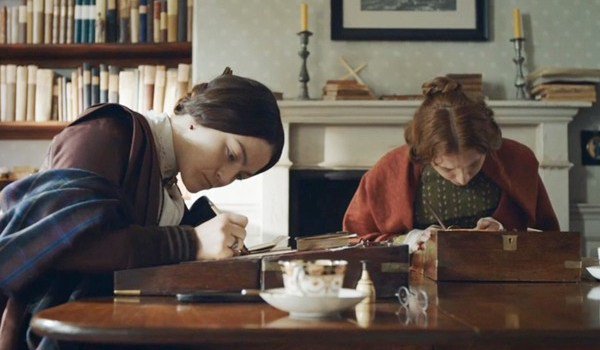
To Walk Invisible: The Lives of the Brontë Sisters

Look, I'm not going to mince words here. To Walk Invisible is a surprisingly beautiful, yet painfully authentic look at the real life experiences of these three remarkable women. And it's that "real life" aspect that was so important to capture, since that was precisely what they wrote about, and what caused their novels to be so controversial at the time.

The brilliant Sally Wainwright wrote and directed this television film, bringing the same passion for the story and compassion for her characters that she has given two of my favorite female-centric British dramas, Happy Valley and Last Tango in Halifax. In fact, Wainwright has made a career out of telling the stories of women, both from history and from modern times. And it looks like she's going to continue this trend with her next project Shibden Hall, a series about the life of Anne Lister, who was an adventurer, mountaineer, traveler, and who has been called "the first modern lesbian."


I am certainly no expert on the lives or works of the Brontë Sisters, having only read Charlotte's Jane Eyre. In fact, I remember being somewhat overwhelmed with the bleakness of the story when I first read it as a teen, and subsequently refused to even consider reading Emily's Wuthering Heights. Reading Jane Eyre again a few years ago when I was quite a bit more mature, I was better able to appreciate the story's brutal honesty about the lives of its characters and place the story into its historical context.

I am a bit ashamed to admit that Wuthering Heights is still on my to-read list. After watching To Walk Invisible I am inspired to move it closer to the top, along with The Tenant of Wildfell Hall by Anne.

If you know even a little about the lives of these three sisters, you may be a bit worried this film will be filled with tragedy. And rightly so. The level of misfortune this poor family experienced in one generation is heartbreaking to read about with nearly 200 years distance. Fortunately, while the deaths of their mother and older sisters are briefly mentioned, this film picks up the story when they are all adults and those deaths are well behind them.


It takes place over the short period where the three sisters and their brother Branwell were all living at home again with their father. After a short introduction to the imaginary childhood adventures the four of them dreamed up, we quickly learn that Branwell is struggling to adjust to the demands of adult life and unable to stay sober long enough to pursue his passion for writing or painting. The three sisters, feeling trapped in the constricting gender roles of the 1840s, devise a plan to become published authors themselves, keeping it a secret from everyone else, including their father, and especially their brother. Together, they conspire to write a collection of poems to be published under pseudonyms, and then use that as a means to launch their careers as novelists. And, remarkably, it works.


The story has plenty of drama and sadness. And while the film ends on a sad note, what lingers in my mind is the earlier triumph when the three sisters finally share their secret with their father, who is absolutely thrilled to learn his three living daughters are all successful authors. The scene where Charlotte reveals to him that she is the author of Jane Eyre in one of my favorites. He is initially surprised and maybe even a bit skeptical, but then he is overcome with pride. And I was overcome with emotion as well.

More than anything, though, what I love the most about this film is its depiction of the relationships between these women. The tender and loving bond between Anne and Emily is so refreshing and actually quite moving. We so rarely see that level of physical contact between two people on screen that isn't sexual. And the genuine respect and support each sister gives the others makes this film one I will watch again and again. To Walk Invisible earns the Self-Rescuing Princess Society seal of approval for many reasons, but especially for its representation of female friendships.


If you have not watched it yet, I highly recommend To Walk Invisible. I was able to stream it through PBS Masterpiece because I am a member of my local PBS station. Otherwise, if it is no longer being broadcast by your local station, you may have to purchase it through iTunes or Amazon. It is worth the cost, trust me.

I can't do the work of SRPS without your your support!
If you like what you read here, please share this post with your friends.

Tuesday, October 27, 2015

Quote of the Day - Maxine Hong Kingston

Today is the 75th birthday of the amazing Maxine Hong Kingston. She is best known for her memoir The Woman Warrior, which tells stories of her life interspersed with traditional Chinese folktales. I have never read the whole thing (a fact I am somewhat ashamed of, frankly), but we did read excerpts of it in several of my college classes about race and gender.


To me success means effectiveness in the world, that I am able to carry my ideas and values into the world - that I am able to change it in positive ways.

Thursday, October 22, 2015

Quote of the Day - Ursula K Le Guin

Today is the 86th birthday of the legendary science fiction author Ursula K. Le Guin.

"We are volcanoes. When we women offer our experience as our truth, as human truth, all the maps change. There are new mountains."
I love this quote. I love the power of it. Our stories are powerful. I think that's why Ursula K. Le Guin's works resonate so strongly with so many women: she's telling their story. They can see themselves in her worlds, and for what too often is the first time in their lives, they feel connected and powerful.

One fun fact I just love about her:

Tuesday, September 29, 2015

She's a Genius - The Women of the 2015 MacArthur Foundation Fellows Program

The Class of 2015 MacArthur Fellows has been announced and, again, it's an exclusive club of brilliant minds -- scientists, artists, and thinkers -- who are challenging what we already know and leading us in new directions. This program is nicknamed the "Genius Grant" for good reason: each recipient is being honored for their ability to think in a completely new way, applying their particular brand of "genius" to whatever passion they pursue.
"Talent hits a target no one else can hit; Genius hits a target no one else can see." Arthur Schopenhauer
This year nine remarkable women are being recognized for their efforts to share new discoveries, show us new ways of interacting, and bring us closer to the truth about what it is to be human.

Wednesday, September 9, 2015

Kickstart This! Comics Edition

I went looking for a great crowd funding project to share with you today, but instead found soooo many I had to lump them all together into their own list posts. Here's the post of all the awesome comics and graphic novels that are looking for a little support. Each is the project of creative and clever women, and each features smart, brave, and seriously kickass women.  Give these projects a look, and maybe even pick one or three to back.


Sirenne Sisters Investigation by Stone and KaaChan, is a mad cap adventure through Victorian steam punk mysteries and chilling tales of horror with the Sirenne Sisters!
And that's where the Sirenne Sisters Investigation team comes in! A group of specialists in the world of of the Paranormal, here at your service! Composed of three Sisters; the eldest sister, Victoria, is the strong and dependable force behind SSI. The youngest sister would be the chipper and charming, fashion-forward Catherine; and the middle sister Elizabeth, the gear-oriented mechanic of the group. Together, they protect mortals from the darkness that lurks in the unknown world that coincides with our own.


As a part of the Feminist publisher Zubaan Books, with The Goethe Institut, created a week-long workshop with a group of Indian women, to share their stories. The result was something remarkable.
Drawing the Line: A Comics Anthology by Indian Women, by Nicole Marie Burton, is a collection of 14 accounts of lived experience by women in India. Stories cover topics about gender, sexuality, harassment, coming of age, family, sisterhood, race, shadeism, class, and political struggle in a country that many in the West know little about, and understand even less.


Oath Anthology of New Heroes, by Audrey Redpath, is a queer superhero comic anthology by queer creators, creating representation we deserve in a book everyone can read.
Our heroes aren't cautionary tales. Stories in the anthology will empower unquestionably queer characters and creators, and saturate heroic plots and settings with new perspectives.


Big Brown Eyes is a collective composed of three sisters: Emily, Karis and Freya Lambert, aiming to launch their first 'zine at the Bristol Comic and Zine Fair in October. Based on the artwork in their Kickstarter post, it looks like it will be a beautiful 'zine. I fully expect to see more by these creative young women in the future.
We will be showcasing our debut zine Beginnings, themed on creation, development and cycles, as well as our individual comics at the Bristol Comic and Zine Fair 2015 on October 3rd.


Poizon: Lost Child Hardcover 20th Anniversary collection by Bad Girl Artwork looks like a pretty kickass comic.
Annique Talbot lives in Queen City in the year 2072 during a time of war between humans and demons, a war humanity is losing badly. In this time Razor is a force for evil and the bride of Lucifer's agent on earth Anvil. Taking the name Poizon she is a powerful psyonic she is able to form a bubble of energy around her as barrier physical objects cannot pass but the more pressure placed on it the more effort it takes to sustain. She also has a strong psychic ability and is able to communicate over time and space with desired targets. Important to the Razor story it was Poizon that tended to the fallen Razor after her battle with Stryke. She followed Razor into Limbo and tried to persuaded her to come back to earth to finish her work instead of finding the peace and rest she so longed for. Razor chose peace only to be dragged back to earth by other undead forces.


Strange Wit, by Katy Rex, is an original graphic novel about Jane Bowles, an incredible author, inspiring woman, and tortured mind.
Jane may have been marginalized by the cultural canon, but her contemporaries considered her “one of the finest modern writers” (John Ashberry), “the most important writer of prose fiction” (Tennessee Williams), and further, a “genius imp, [a] laughing, hilarious, tortured elf” (Truman Capote). Jane drank more than she wrote, worried more than she worked, and had more epically disastrous love affairs than completed books. By almost any measure, Jane led a fascinating life filled with literary giants and great adventure and I want to bring her story to life.


Jill Trent, Science Sleuth #2, by D.M. Higgins, is a modern re-awakening of the original Jill Trent, Science Sleuth from the mid-1940s, filled with stories of science, mystery, & adventure!
Now, more than 65 years later, we've brought Jill and Daisy back! Jill Trent, Science Sleuth #2 is a 28-page comic book featuring 3 all-new stories by 3 creative teams! By popular demand, these stories are slightly longer than those in Jill Trent #1 — a full 8 pages each! Each stand-alone story reimagines the Science Sleuths in a new way, including a range of racial and ethnic identities and time periods, from the 1940s to the not-too-distant future.
If you like the work I do here at Self-Rescuing Princess Society,
sharing great projects by kickass women, please check out my Patreon.

Wednesday, September 2, 2015

SRPS Book Shelf - Shay & Ivy: Beyond the Kingdom

A while back I wrote about a Kickstarter for a great book -- Shay & Ivy: Beyond the Kingdom, by Sheena McFeely and Casie Trace.
Shay and Ivy have discovered that the princess culture might seem glamorous at first, but usually tends to become a bit uncomfortable when it won't let you do science experiments or travel into space.
Recently I received a digital copy to review. I was pretty sure going in I was going to love this book based on what I already know about it from writing about their Kickstarter, but I was still excited about seeing the book for myself.
The first book is about Shay & Ivy and their friends, at an imaginary ball in their bedroom, dreaming of being princesses. They all dreamt of riding horses, owning closets full of gowns, and dancing in royal castles. All girls, but Shay felt out of place. How was she to royally fit in if she did not want to be a princess anymore?

Determined as ever, Shay was going to find the answer. Shay & Ivy soon find out that their dreams go beyond a kingdom. The sisters began to visualize themselves as fearless pilots riding planes, scientists owning labs to perform experiments, and astronauts dancing among the stars.


As it turns out, there are several reasons why I love this book, though. Obviously, I love the idea of making sure girls know they can be "more than a princess." To be sure, there's absolutely nothing wrong with being a princess. I'd be the last person to say that. But one can be a princess while also being so much more. And the more times we tell girls that, the better chance we have of it sticking!

Saturday, March 21, 2015

Weekend Reading

Norman Garstin, In A Cottage By The Sea, 1887

Here we are at another weekend! I'm so excited because I've found loads of great stuff to share with you. We've got two very different stories about women in sports, showing how different prevailing attitudes can have dramatically different effects. There's a beautiful piece about the amazing Jane Goodall. And Linda Holmes of NPR goes in-depth in trying to understand the fascination with the Cinderella story and how each new re-telling tells us more about ourselves than it does about the actual princess. Then there's a piece about how a science academic writing a romance about a science academic taught her more about herself and her colleagues than she had expected. And finally, a wonderful conversation between two of my favorite modern feminists!

So let's dive right in!

Photo: Kate Warren


Regardless of how you feel about the sport of boxing, you have to admit it takes a special kind of bravery to get into the ring for one round, much less to try and make a career out of it. And women boxers have to have the most bravery of all -- not just to face their opponents, but to face the uphill battle of winning over coaches, promoters and the public. Kate Jenkins' piece for The Atlantic, The Real Knockouts of Women’s Boxing, digs deep into the life of one boxer trying to make it, and the battle that switches between foes of blatant sexism and cool indifference.
That’s exactly what today’s women fighters are doing: staying light on their feet, waiting for the perfect opening. They’re struggling to maintain their balance and their sanity. Nelson has found hers in God, and she keeps training, keeps delivering pancakes, with the faith that her dedication will give way to an answer. If she could eat title belts, Nelson wouldn’t have a care in the world. But undefeated or not, there’s no clear strategy for turning her athletic success into financial success just yet.

Meanwhile, Douglas struggles to keep her anger from controlling her. She once thought boxing could help her overcome a past filled with abuse and foster homes, but after she debuted as a pro, a bad experience with a promoter left her jaded. “They told me, ‘You need to change the way you dress, you need to put on makeup, do this, do that,’” she says. “They were trying to change everything about me, and I wasn’t having it.” The promoter also dragged her out to nightclubs, where they’d hang around with wealthy men who frequently propositioned Douglas, implying that they’d take sex in exchange for financial support. “It really used to bother me. I used to cry. Now I’m like, ‘How ’bout I break your jaw?’”
Courtney Force greeting her fans. Photo: NHRA


Tony Fabrizio's great piece in ESPNW, How the Success of Women Drivers in NHRA Engages, Inspires Fans, shows that if nowhere else in racing, at least in the NHRA there are excellent opportunities for women racers, which is fueling the overall success of the brand, as well as attracting whole new segments of the population to the races.
Anecdotally, though, anyone can clearly see a difference in the NHRA pits and grandstands.

"The women are out there," [Gary] Darcy said. "The young girls are out there. And when you see somebody like a Courtney Force, a Leah Pritchett, both boys and girls are paying attention, but certainly you see the young girls and the moms that are there trying to get a glimpse. Because it does become very inspirational, and they see somebody doing what they could maybe do one day.

"That's the great thing about our sport. Those barriers don't exist."
Jane Goodall on Lake Tanganyika. Photo: Michael Christopher Brown/Magnum
Paul Tullis' article Jane Goodall Is Still Wild at Heart is as amazing as you would want it to be. Last summer he traveled with her to visit her old research facilities in Gombe, making note of her interactions with tourists and officials alike, and perfectly capturing this remarkable woman's talent for patience and determination.
But if her interactions with government officials from the United States, France, Tanzania and Burundi, as well as executives from Silicon Valley, are any indication, the skill sets are not so different: patience, purpose, perception. It took her only a few months of observing chimps before Goodall noticed that some of their behaviors were remarkably similar to those of humans. Now, perhaps, it has come full circle: Her understanding of people has been informed by her time spent with chimps, giving her an intuitive power of persuasion that even she does not seem to consciously grasp.
Photo: Disney
You think you know the Cinderella story, but do you really? I love Linda Holmes, and this piece she wrote for NPR, A Girl, A Shoe, A Prince: The Endlessly Evolving Cinderella, is just plain brilliant. In it, she discusses the background of the Cinderella story and its variations from around the globe, and why it still has such a powerful hold over our imaginations.
The actual Cinderella tale, while a nebulous thing that can be hard to pin down with precision, is more than that. There's very little that's common to every variant of the story, but in general, you have a mistreated young woman, forced to do menial work, either cast out or unloved by her family. She has an opportunity to marry well and escape her situation, but she gets that chance only after being mistaken for a higher-status person, so she has to get the man who may marry her to recognize her in her low-status form, which often happens either via a shoe that fits or some kind of food that she prepares.
In this fantastic guest post over at Tenure, She Wrote, Physicist T.K. Flor writes about her experience writing her novel Initial Conditions, about a female scientist pursuing a career in academia, and the problems so many women in that world face.
For me is was very valuable. It gave me a broader view about professional compromises and personal choices. Moreover, a novel-length format provides something unique: it gives the readers (and the writer) an opportunity to experience the situations emotionally. One can then get a richer impression of what is going on and what kinds of pressures a woman-scientist feels, and what drives those around her. It is such understanding, rather than any practical advice, that may help women in science.
Oh yes! You absolutely have to watch this conversation between Tavi Gevinson, founder and editor in chief of Rookie Magazine, and Anna Holmes, founder of Jezebel.

Wednesday, March 11, 2015

Kickstart This!

I have always had a fondness for longform journalism. While I understand the appeal of short, easy to process pieces, some stories deserve a longer, more in-depth telling.

So when I saw that the folks behind the Riveter Magazine online site were working on publishing a quarterly, I was intrigued. Longform pieces written by and about women? Yes, please!
The Riveter is a women's longform lifestyle magazine in print and online, dedicated to exposing the power of women as longform journalists. It is an effort to fill the void that exists in women's media and to diversify the narrative surrounding women in publishing. The Riveter publishes stories that can't be summed up in a sell line, because women, as writers and readers, deserve more from a women's magazine.
This is so very important right now! While it may sometimes feel as though women's stories are easier to find than ever, it's still nowhere near how it should be. And female journalists still have a difficult time finding jobs in the industry.
As journalists, we noticed a gap in the industry. According to this Nieman Report, in 2013, only 37.2 percent of journalism jobs were held by women, whereas women received 62.5 percent and 67.6 percent of bachelor's and master's degrees in communications respectively -- statistics that were consistent with what we noticed in journalism school. Never mind the almost $10,000 income gap in the industry. So, where did all of the lady-journos go?


So, if the telling of women's stories and supporting women in journalism is important to you, please consider supporting their Kickstarter campaign. If $60 sounds steep to you, keep in mind that print journalism is expensive, and while magazine subscriptions tend to be around $20 a year, that is subsidized by advertisements -- advertisements that may (although shouldn't) have some impact on the content you're reading.

While much of what we read online is free, the price to pay the authors and artists has to come from somewhere -- whether it's from ads, or some other way. Many sites have been switching to a subscription model over the last year or so, because otherwise they simply cannot afford to pay their staff what their time and talent is worth. It is up to us readers to put our money where our mouths are, and pony up some cash to support our favorite publications.

Saturday, March 7, 2015

Weekend Reading

It's Saturday again! Out here in California, it's a beautiful, sunny, warm day. The mockingbirds are busily singing, singing, singing, and I think I'm going to take my e-reader out into the garden and enjoy some sunshine.

I hope no matter what the weather is like where you are, you can at least get some time in relaxing and enjoying something good to read. Check out some of the pieces I've linked below to start off your weekend. And, as always, feel free to share links to articles you're reading and enjoying in the comments.

Beginning farmer Lindsey Morris Carpenter humanely raises livestock at Grassroots Farm in Wisconsin. Photo: Anthony Wahl


I feel very fortunate that I know a lot of the people who grow my food or otherwise work in the agricultural world. So many of them are amazing women who are fighting not just to make a living, but to make real change. Sena Christian interviews several women who've taken up the mantle, and writes about the evolving face of our food systems in her piece Unconventional Agriculture.
Many of these women are part of a growing crop of new farmers – both men and women, between the ages of 25 and 34 – who have taken to working the land in the past decade. They aren’t necessarily your typical young farmers, either. Many are college-educated and did not inherit farmland or come from a family of farmers, suggesting a more purposeful motivation for entering such a tough profession.
Reading through this collection of "Tiny Rebellions" put together by the ladies at Rookie Magazine totally made my day!
Harmless, moooostly subtle acts of defiance are ways to push back against the jerk-itude, mundanity, and unfairness we encounter on a daily basis. Stirring the pot just a little bit also makes life more interesting—for you and anyone who’s paying close enough attention to what you’re up to. Here, we share some really good ways to be bad (but not actually bad).
This one by Tova made me laugh out loud:
When I was younger, we had to pray every morning in school for an hour or more. I worked really hard to move my lips and move the pages at the right times so it appeared as though I were devoutly praying, but all the while I was making up (spiteful) stories about my teachers in my head. In retrospect, it would have been less work to just pray, but I got such a kick out of it all.
Athena Volunteers. Credit: Jodie Chiang


I'm a bit late on sharing this, as the 2015 Athena Film Festival has already come and gone, but this piece by Lesley Coffin for The Mary Sue is still a worthy read to understand why it's so important to celebrate the work of women in Hollywood, and to push for change in the film industry.
Being someone who writes about film myself, I am of course more than familiar with Women and Hollywood, and was curious how it even started. Speaking with Silverstein, she recounted how a moment of frustration was her inspiration. “One day I was at the movies, because that is what I always did,” she said. “But as I was getting older, I went to the blockbuster films, [and] I said to myself, ‘These all suck, and I don’t see anyone like me here.’ So that kind of stuck in my head and I was doing other things and learned about the blogosphere. And I have always been a person interesting in pop culture and feminism, and there was this light bulb day.”
Photo: Joey Hi-Fi

Here in the US, and likely in the UK as well, we almost take it for granted that our SciFi/Fantasy will be somewhat representative of our larger culture. It'll be written by someone who lives a similar life as us, and have something to say that can be directly related to us. We maybe never stop and think about what people in other parts of the world want to write or read. So this piece by Lauren Smith reviewing some of the most important SF/F coming out of South Africa really intrigued me.
I know it was – and probably always will be – vital for us to have overtly sociopolitical literary fiction, but even as a non-white person growing up in a disadvantaged community, I seldom felt that this fiction resonated with my experience of South Africa or catered to my interests, which – shockingly – aren’t defined by the way apartheid screwed me and my family over. I’ll never be free of apartheid’s legacy, but at the same time I’ll never be so consumed by it that I expect everything we create to carry all the miserable weight of history. I don’t want to put an end to political fiction rooted in stark reality; it’d just be nice to have lots of other stuff too.

So when Lauren Beukes’s debut novel Moxyland came out, I was really happy. Suddenly local fiction could be fun and full of exciting ideas. It could have a thrilling plot that, for once, happened in the same place that I lived. It could still acknowledge or engage with our troubling history and the grotesque inequality it left behind, but it could do that without making me feel like I was chained to the past. And it could even – *gasp * – not be about South Africa at all!