Kickass Women

History is filled with women doing all kinds of kickass stuff.

Smart Girls

Watch these girls... they're going places!

Inspiration

Need a dose of inspiration? Here you go.

SRPS Entertainment

Some of my entertainment recommendations with awesome female characters and stars.

She's Crafty!

Some of the awesome items made by kickass women!

Showing posts with label young women. Show all posts

Thursday, May 18, 2017

Jessica Watson: Brave Girl

Today's the 24th birthday of kickass adventurer Jessica Watson.

Seven years (and three days) ago, on May 15, 2010, 16-year-old Jessica Watson became the youngest person to complete a solo trip around the world. It was the completion a dream she had when she was 12, inspired by a a book her mother had read to her and her siblings.


What kind of bravery is needed to head out onto the ocean alone at the age of 16, knowing if you're successful you'll be spending eight months completely alone? Whatever it is, it's clear Jessica Watson had plenty of it.

During her adventurous voyage, she was responsible for repairing damage to her boat, navigating around or through storms, and keeping herself motivated to continue. While sea, she blogged about her experiences.

These days, she still sails quite a bit, when she can find time in her busy schedule. More often, though, she travels around the world by airplane, serving as a Youth Ambassador for The United Nations World Food Programme.

She's written about her experience in her book True Spirit

You can read more about her historic voyage as well as what she's working on now on her blog

You can read about her work with the UN's World Food Programme

I can't do the work of SRPS without your your support!
If you like what you read here, please share this post with your friends.

Tuesday, May 2, 2017

SRPS Role Model: Malala Yousafzai

“I know where I stand. If you stand with me, I ask you to seize every opportunity for girls’ education in the next year... We should not ask children to flee their homes to also give up their dreams, and we must recognize that young refugees are future leaders on whom we all depend for peace.”
Last month Malala Yousafzai become only the sixth person, and the youngest, to receive honorary Canadian citizenship, a title conferred on "foreigners of exceptional merit." Malala certainly qualifies as a young woman of exceptional merit! Through her bravery and dogged determination, she is actively creating a better world by advocating for girls' right to education worldwide, and is currently serving as a UN Messenger of Peace.

Most people have already heard Malala's story of being an 11 year old blogger for the BBC sharing stories about her life as a girl under Taliban occupation. In particular, she was outspoken about the need for education for girls, which had been banned. Although her identity was kept secret, the Taliban eventually discovered who she was and targeted her in an attempt to silence her. And they almost succeeded. Her shooting injuries were quite severe, but she was airlifted to the UK where she was able to receive extensive medical care.


The attempt on her life emboldened this brilliant and brave young woman. With her best-selling book, I am Malala [Amazon/Library], and the non-profit Malala Fund, she has made it a point to use her public platform to continue the call for at least 12 years of schooling for all girls around the world.

Prime minister Trudeau echoed the thoughts of many of her supporters in his speech at the ceremony. "Malala, your story is an inspiration to us all. For bravely lending your voice to so many, we thank you."

It is her remarkable bravery and her dedication to such an important cause that makes her a Self-Rescuing Princess Society role model. Young people around the world can see her and find inspiration to speak up and take action. Like Canadian student Sabina Haque said at an event prior to the ceremony, "It’s really nice to have someone like Malala — a young women, a woman of colour from a community where she was undermined for her gender — be able to rise above and stand up for girls and education."

The ceremony was held on April 12, 2017, in the Canadian House of Commons, where prime minister Trudeau presented her with a certificate of honorary citizenship and a Canadian flag. It had originally been slated for 2014, the same year she was awarded the Nobel Peace Prize, but had to be postponed because of a tragic shooting of a soldier in Ottawa.

You can read more about the official ceremony in the Al Jazeera story: Malala Yousafzai made an honorary Canadian citizen

You can read about the reception she received in Ottawa in the National Observer story: Greeted by screaming fans, Malala Yousafzai becomes a Canadian

You can learn more about her by watching He Named Me Malala [Amazon]

I can't do the work of SRPS without your your support!
If you like what you read here, please share this post with your friends.

Monday, February 6, 2017

My Name is Celia: The Life of Celia Cruz

My Name is Celia/Me llamo Celia: The Life of Celia Cruz/la vida de Celia Cruz
by Monica Brown, illustrated by Rafael Lopez

My Name is Celia/Me llamo Celia: The Life of Celia Cruz/la vida de Celia Cruz (Amazon / Library) is my favorite of the many children's books I've read in the last couple years. The book was so much fun to read. Rafael Lopez' illustrations are bright and colorful and perfectly capture the joy of life in Celia's music. The text perfectly captures the rhythm and cadence of Salsa.

Monica Brown takes us on a musical journey through Celia's life, starting as a young girl growing up in Cuba surrounded by the love of her large extended family, and through her adventures following her love of singing and performing. But even though she has to leave her beloved Cuba, she carries the warmth of her memories and pours them into her performances, so perfectly captured in her signature call of "Azucar!"

My Name is Celia/Me llamo Celia: The Life of Celia Cruz/la vida de Celia Cruz (Amazon / Library) is told in English and Spanish, with each on the same page, making this a great book for bi-lingual kids, or kids who are learning a second language. It's a book that's great for middle-grade readers to enjoy on their own, but it is also perfect as a book for younger kids sitting on mom or dad's lap, swaying to the music, jumping to the beat, and dancing around.

[Note: I have included Amazon Affiliate links in this post. I am exploring options for increasing my income from this blog to help me to continue to bring you the important stories of kickass women and girls. While I will always work to tell these stories, I have bills to pay. By all means feel free to look for these books elsewhere if you prefer. If you want to help support the work I do here, please consider using these links to shop.]

I can't do the work of SRPS without your your support!
If you like what you read, please share this post with your friends.

Celia Cruz, Queen of Salsa

Celia Cruz, Queen of Salsa
by Veronica Chambers, illustrated by Julie Maren

Celia Cruz, Queen of Salsa (Amazon / Library) tells the story of Cuban-American singer Celia Cruz, starting as a child whose job is was to sing lullabies to her younger siblings through her career as she moves from Cuba to the United States following her passion for the music of her home.

Veronica Chambers brings her story to life beautifully with words that flow over each page, and Julia Maren's artwork captures the spirit of a young woman stretching for her goals in life.
"When she opened up her mouth to sing, she heard a girl like any other. But when she sang... Her father heard thunder. Her cousins heard the call of the sea. Her neighbors heard a hummingbird."
Celia Cruz, Queen of Salsa (Amazon / Library) is a good book for middle-grade readers, with a paragraph or two on each page with a facing page of illustration. It's an excellent introduction to Celia Cruz' life and career told in a way that's easily understood by younger children as well, and includes relevant words in Spanish, with a glossary in the back.

[Note: I have included Amazon Affiliate links in this post. I am exploring options for increasing my income from this blog to help me to continue to bring you the important stories of kickass women and girls. While I will always work to tell these stories, I have bills to pay. By all means feel free to look for these books elsewhere if you prefer. If you want to help support the work I do here, please consider using these links to shop.]

I can't do the work of SRPS without your your support!
If you like what you read, please share this post with your friends.

Simi Azimi - Shaolin Wushu Club director

Look at this sword-wielding badass woman!

That's Simi Azimi, leader of the Shaolin Wushu club in Kabul, Afghanistan, where she's teaching 9 other young women and girls the ancient Chinese kung fu martial art.

"I like to help girls in my country in order to improve their skills, so they can be the same as girls in other countries. Also, I want to help bring an end to violence against women in Afghanistan." Sima Azimi

Simi Azimi is only 20 years old, but she's already an award winning kung fu athlete. She trained in Iran for several years, but returned to Kabul to share her skills in the hopes of building support for a national team to participate in the Olympics. Martial arts are quite popular in Afghanistan, but only for men. Women's participation in sports in extremely limited, and especially for contact sports like kung fu. But Simi is hoping to change that.

Her father encouraged her to study martial arts when she was younger and the family was living in Iran. While in Iran she participated in competitions, winning a gold and bronze medal. Now, back in Kabul, he helps her continue her training. She uses her experience to encourage parents to allow their daughters to take lessons in kung fu for self-defense: once a thief grabbed her purse, but Simi fought back and ran him off.

But she also recommends martial arts for the mental and emotional benefits. "It's really effective for body and soul." And for the confidence that comes along with both the strength and mental training. Her students are mostly Hazara, a Persian-speaking minority in Kabul, but she's hoping to expand her class to include more girls from other ethnic groups.

It might be a tough goal to accomplish. Her students have to deal with increased abuse and taunts for breaking the social restrictions limiting activities for women, as well as the increasing dangers they face as a Shi'ite minority targeted by the Islamic State militants. But student Shakila Muradi says they aren't going to be deterred. "There are many people harassing us but we ignore them and follow our goals."

Read more about the Shaolin Wushu club.

See more beautiful photos by Mohammad Ismail featuring the Shaolin Wushu club.


I can't do the work of SRPS without your your support!
If you like what you read, please share this post with your friends.

Wednesday, January 25, 2017

Talkin' About Bessie

Talkin' About Bessie: The Story of Aviator Elizabeth Coleman
by Nikki Grimes; illustrated by E.B. Lewis

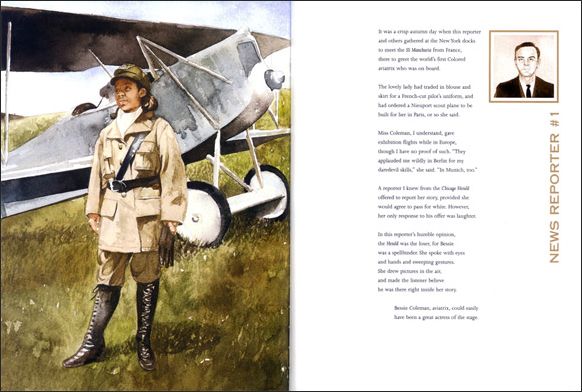
Talkin' About Bessie: The Story of Aviator Elizabeth Coleman (Amazon / Library) is an absolutely beautiful telling of the life and adventures of the amazing Elizabeth "Bessie" Coleman. Nikki Grimes, award-winning author (she just won the 2017 Wilder Award!), brings us into Bessie's world through the voices of the people who knew her best. Each page features a portion of her life story as though a member of her family or a close friend was talking to us about what inspired them most about her.

Each tale is exquisitely illuminated with a painting by E.B. Lewis, who magically creates images the reader can practically step into and experience for herself.

Her sister, Elois Coleman tells about the time Bessie decided to move from rural Texas to Chicago to find the thing she knew was waiting for her, even if she didn't quite know what it was yet.
By twenty-three, she'd discovered a newspaper from Chicago
which boasted of a better life up North
and featured stories of powerful women of the Race:
writers, business tycoons, and civil rights workers
like Ida B. Wells, Madame C.J. Walker, Mary Church Terrell—
full-of-hope and headstrong women. Like Bessie.
Her brother John Coleman talks about her time in Chicago and the day her mind caught hold of the dream of flying, and she then and there set her mind to learn how though there weren't any black pilots anywhere, and no flight schools in the US would accept a black woman.
That's when I knew: by whatever miracle
was required, Bessie would learn to fly.
Robert Abbott, editor of The Chicago Defender, the leading newspaper for the African American community, saw the remarkable potential in Bessie, and funded her trip to France to take flying lessons and return to Chicago as the first black woman anywhere to earn a pilot's license.
Bessie's copper color gave the truth of her away.
For, at the core, she—though slight in appearance—
was tough as any metal, and always ready and willing
to test her strength.

And finally we hear from Bessie herself, as she talks about the pure happiness she found in the air.
But flying at Checkerboard Field in Chicago was the best.
My family and friends were there in the stands,
cheering me on as I sliced through the air.
Oh Mama! I wish you could've been in that plane
to feel that magnificent machine shudder
with the sheer joy of leaving the ground.
Talkin' About Bessie: The Story of Aviator Elizabeth Coleman (Amazon / Library) wins the Self-Rescuing Princess Society seal of approval for sharing both the struggles and determination that led Bessie Coleman to France, as well as her thrill of success and her drive to share her love of flying with the rest of her race -- lifting them up in more ways than one.

It is a perfect book for early readers though middle-grade children, and its illustrations make it appealing to younger kids as well. Heck, it's so gorgeous, it would make a lovely coffee table book for adults. The story doesn't shy away from the painful truths of Jim Crow and being a black child growing up in the land of cotton in the early 1900s. Instead Nikki Grimes explains these hardships in a way that even young children can understand and process. There's a reason this book has received the Coretta Scott King Award twice -- one for the author, and another for the illustrator. It is a breathtaking book about a truly inspirational woman.

[Note: I have included Amazon Affiliate links in this post. I am exploring options for increasing my income from this blog to help me to continue to bring you the important stories of kickass women and girls. While I will always work to tell these stories, I have bills to pay. By all means feel free to look for these books elsewhere if you prefer. If you want to help support the work I do here, please consider using these links to shop.]

I can't do the work of SRPS without your your support!
If you like what you read, please share this post with your friends.

Monday, January 23, 2017

Anna Maria's Gift

Anna Maria's Gift
by Janice Shefelman; illustrated by Robert Papp

An engaging book about a talented young violinist adjusting to a new life as an orphan after her father dies, overcoming her grief and learning how to forgive.
When Anna Maria's father dies, she moves to an orphanage in Venice. Though she misses her father, she knows he will always be with her, as long as she has his beautiful violin. Luckily, the orphanage is also a renowned music school, with a teacher who is none other than composer Antonio Vivaldi. But when her violin is stolen, Anna Maria must search Venice's bridges, streets, and canals. Will she ever find it—and can she ever be happy in Venice without it? This lyrical historical-fiction story captures Venice, the joy of music, and how kindness can make a scary new place feel like home.
I was surprised to learn that Anna Maria's story is based in history and the orphanage she was sent to actually existed. The Ospedale della Pietà was founded by a Franciscan priest as a place for children who had been abandoned as well as for orphans like Anna Maria, whose parents died from an unmentioned disease.

It is also true that composer (and priest) Antonio Vivaldi ran the music program for the Pietà. Originally the funds for the orphanage came from donations and public funding, but as the number of children grew the funds did not. In the 17th Century, someone had the idea to organize some of the more musically talented girls in the orphanage as a group of performers for the religious services. This was a brilliant idea, as wealthy Venetians began to attend these services in order to see these talented girls perform. Over the next two centuries, countless girls were given a top-notch musical education, and trained at least two composers: Anna Bon and Vincenta Da Ponte.

Anna Maria's Gift (Amazon/Library) gets the Self-Rescuing Princess Society seal of approval for showing a brave girl facing her troubles head-on. The crux of the story involves jealousy and bullying by another orphan at the Pietà, Paolina, but that is resolved by the end of the story as the adults try to foster a sense of understanding and mutual support between the two girls.

Anna Maria's Gift is a charming book perfect for young readers in the 8 to 10 year old range. It is organized into chapters with several line drawings highlighting the story, and includes a glossary in the back covering words that might be new to them. And it even has a brief historical note, which lead me to do my own research about Vivaldi and the Pietà.

[Note: I have included Amazon Affiliate links in this post. I am exploring options for increasing my income from this blog to help me to continue to bring you the important stories of kickass women and girls. While I will always work to tell these stories, I have bills to pay. By all means feel free to look for these books elsewhere if you prefer. If you want to help support the work I do here, please consider using these links to shop.]

I can't do the work of SRPS without your your support!
If you like what you read, please share this post with your friends.

Monday, January 16, 2017

Read This: Claudette Colvin: Twice Towards Justice


Claudette Colvin was a teenager growing up in Montgomery, Alabama, in 1955, and she was tired of the daily struggle to survive in a world ruled by Jim Crow.
"I was done talking about 'good hair' and 'good skin' but not addressing our grievances. I was tired of adults complaining about how badly they were treated and not doing anything about it. I'd had enough of just feeling angry... I was tired of hoping for justice. When my moment came, I was ready."
Her moment came on March 2, 1955, when she was arrested for refusing to give up her seat on the bus. A full nine months before Rosa Parks did the same, in the same city. We know Rosa Park's name and story (or at least we should!), but what do we know about Claudette's? What role did she play in the fight for equality? What effect did her refusing to give up her seat have on the movement in Montgomery?

In Claudette Colvin: Twice Towards Justice (Bookshop / Amazon / library) Phillip Hoose does a remarkable job of not only sharing Claudette's background, but he places her story within the larger civil rights timeline. He gives us a good understanding of her life growing up in Jim Crow Alabama -- her stories of experiencing racism first hand, watching her family and neighbors struggling with oppression, the influence of special teachers, and the natural questioning of a young woman determined to make a place for herself in the world -- that ultimately led her to fight back in such a publicly dangerous way.

The more I read about Claudette's life and the events leading up to her decision to stay in her seat on March 2, the more I admired her strength, her conviction, and her absolute bravery. She wasn't only taking a momentary stand against the overt racism of the people on the bus with her, she was fighting the decade's long state laws enforcing segregation on the buses. Because she was breaking the law, she knew she could be arrested (she was) and almost certainly putting herself in the extremely dangerous position of being a young black woman at the mercy of white male police officers who had shown, repeatedly, they they knew they could act with impunity in some of the most shockingly horrible ways. She knew the stories of black women being raped by white police officers, and others being beaten for any perceived misstep. And then, after her arrest and release, although she would be able to return home, she and her family and their community would very likely be targets of violence from the white community. She knew all of this on that afternoon in March, and yet she stayed in her seat.
"But worried or not, I felt proud. I had stood up for our rights. I had done something a lot of adults hadn't done. On the ride home from jail, coming over the viaduct, Reverend Johnson said something to me I'll never forget. He was an adult who everyone respected and his opinion meant a lot to me. 'Claudette,' he said, 'I'm so proud of you. Everyone prays for freedom. We've all been praying and praying. But you're different -- you want your answer the next morning. And I think you just brought the revolution to Montgomery.'"
Her story doesn't end there, though. The phrase "Twice Towards Justice" in the title refers to two brave acts -- the first being her refusal to move from her seat, and the second her agreeing to join three other courageous black women in a ground-breaking federal lawsuit, Browder v. Gayle. She agreed to testify, answering questions from hostile attorneys and facing intense public scrutiny in the press, because she knew the importance of continuing the fight for justice.
"At night, I would lie in bed and rehearse the things I was going to say, Raymond (her son) slept beside me in a little bassinet. It was just the two of use in the front room, him breathing or fussing or pulling at his bottle, and me thinking about what I would say at trial. Sometimes I thought about Harriet Tubman, about her courage. I prayed I could have her courage on the trial day."
Spoiler alert: she did! She testified to the treatment she received on the bus and from the police offices, and why she and others in the black community had been boycotting the buses. She, a black teenager who'd been told her whole life to defer to whites at the risk of her safety, brazenly looked these powerful men in the eyes and answered their questions without hesitation or backing down. When asked why she stopped riding the buses on December fifth, she answered coolly, "Because we were treated wrong, dirty and nasty." She bravely spoke the truth in the face of overwhelming hatred and oppression. And for this, she deserves to be remembered as a civil rights hero.


Claudette Colvin: Twice Towards Justice (Bookshop / Amazon / library)  is an excellent book for young adults (and older adults, to be honest) who want to know more about Claudette Colvin, the Montgomery Bus Boycott, and the Civil Rights Movement in the mid-1950s. Phillip Hoose gives the reader an excellent understanding of the important issues of the era, with photographs and quotes from people who were there as context for Claudette's story. I learned quite a bit of new information about Rosa Parks and Dr. Martin Luther King, Jr., as well as other important people and events that eventually led to the Montgomery Bus Boycott and its eventual success. While Rosa Parks is remembered for her refusal to move to the back of the bus, Claudette's defiant action and arrest nine months earlier was the spark that pushed the already fed up black community of Montgomery into action.

That alone makes this book an excellent addition to any library. But not content to simply tell Claudette's story, Phillip Hoose was determined to meet with her and hear her tell her own story. The book switches from historical explanation to memoir, with Claudette explaining events from her life in her own words. This is what makes this book such an incredibly powerful read. As he writes in the book:
"More than any other story I know, Claudette Colvin's life story shows how history is made up of objective facts and personal truths, braided together. In her case, a girl raised in poverty by a strong, loving family twice risked her life to gain a measure of justice for her people. Hers is the story of a wise and brave woman who, when she was a smart, angry teenager in Jim Crow Alabama, made contributions to human rights far too important to be forgotten."
Claudette Colvin is still alive. After the Browder v. Gayle, she continued to struggle to support herself and her child in Montgomery, and eventually moved to New York City to escape the hate-filled backlash of violence against blacks raging across the south and especially in Montgomery. When I write about "self-rescuing princesses" I mean people like Claudette Colvin. She never once stopped working for justice. When her moment arrived, she was ready and she held her ground. And then when she needed to, she found a way to persevere and protect herself and her child.
"When I look back now, I think Rosa Parks was the right person to represent that movement at that time. She was a good and strong person, accepted by more people than were ready to accept me. But I made a personal statement, too, one that she didn't make and probably couldn't have made. Mine was the first cry for justice, and a loud one. I made it so that our own adult leaders couldn't just be nice anymore. Back then, as a teenager, I kept thinking, Why don't the adults around here just say something? Say it so they know we don't accept segregation? I knew then and I know now that, when it comes to justice, there is no easy way to get it. You can't sugarcoat it. You have to take a stand and say, 'This is not right.'"
And she did. And you can learn all about her fight for justice -- and get a healthy dose of inspiration for your own fight, as well as inspiring the next generation of social justice warriors -- by reading Claudette Colvin: Twice Towards Justice (Bookshop / Amazon / library) by Phillip Hoose.

I can't do the work of SRPS without your your support!
If you like what you read here, please share this post with your friends.


Disclaimer: SRPS participates in affiliate link programs with Bookshop and Amazon, which are designed to provide blogs like this with a small commission by linking to their sites. What this means is that whenever you buy something after clicking one of the links above, we will receive a small percentage of the price, at no additional cost to you.

Monday, August 24, 2015

TV Night - Switched at Birth

"Sometimes I just wish I could be Daphne. Not deaf, not hearing, just a girl playing basketball."

In the autumn of 2012, I was taking a full load of college classes, working toward my degree. One of my favorite classes that semester was an Adaptive PE class, in which we learned about how to modify physical education and recreational programs for people with physical, cognitive and emotional disabilities. It was also during this time that I discovered season 1 of Switched at Birth on Netflix, and watched it all in one week during break. I was impressed with the show's handling of the specific issues facing the deaf and hard of hearing.


Flash forward three years, and I realized that while I'd stopped after watching season 1, the show had kept going. Two weeks ago I went looking for a new show to watch on Netflix, and found that there were three* more seasons of Switched at Birth to catch up on! Of course, I got started immediately. And I'm so glad I did. Not only was it as good as I remembered, it actually got increasingly better with each season as they expanded on the characters' stories. Plus, my timing was perfect -- I finished last week, just in time for its return for the second half of season 4 tonight (August 24)!

Without going into any spoilery details, here's a short list why you should be watching this excellent show:

Friday, May 22, 2015

Kickstart This! Naked Nomadz

"Disbelief and fear settle into warm homes like unapologetic and unwanted visitors." Rebekah Isreal, Naked Nomad
You might wonder what it is I do when I'm not writing posts for this blog, or hanging out on social media. Well, until a year ago, I was also a full-time college student. When I turned 40, I quit my job and returned to college to finally get that bachelor's degree I'd been putting off for so long.

As a student at Sonoma State University (SSU) in the Environmental Studies and Planning (ENSP) department I finally completed my degree in Outdoor Leadership and Education, with lots of sociology and history classes thrown in for good measure.

I was thrilled beyond measure that I'd finally found a degree program that fit with my personal philosophy. And to make things even better were the wonderful students I got to know. Like these amazing young women below. The Outdoor Leadership and Education program is a wonderful set of classes that teach students how to share their love of the outdoors with the widest audience possible. As you might expect, students spend a significant portion of their class time outside, and sometimes even on some pretty exciting adventures. Naturally, this tends to lead to close bonds that last well after the class is over, and often involves even more extensive adventures.

The Naked Nomads (l to r): Laura, McKella, Sydney, Rebekah, Malina


I was fortunately enough to have several of these young women in the photo above in many of my classes, and was even a bit sad to leave them as I graduated. As it turns out, these hot shots are graduating this year, and to celebrate, they're going on a all-ladies bike tour! One they dreamed up themselves -- 5 women, 800 miles, 30 days. They've nicknamed themselves the Naked Nomads, and the name is so perfectly fitting. You would be hard pressed to find five more genuine and kind souls than these women right here.

This is where you come in. They're crowd-sourcing their trip, and need your help to meet their financial goal to make this trip happen. Here's their explanation from their GoFundMe campaign page:
We are the Naked Nomads.

Who are the Naked Nomads, you ask?

Naked (to us) means:
The stripping down of barriers that keep us from fully immersing ourselves into life, exposing our minds and bodies to the world.

We are five wonderful women from Sonoma County. Cyclists, outdoor enthusiasts, nature lovers, and friends, we met through the outdoor program at Sonoma State University, where we have grown as individuals as well as companions. We are five passionate people about experiencing and seeing the world through the love for adventure. We strive to empower ourselves and others, which has led us to this epic bike tour.

Coming Summer 2015 we are going to push ourselves and our limits by CYCLING TO PORTLAND from June 25 to July 25. A month where the five of us will explore new horizons and discover the willingness to be intimate with nature and life. Living simply and fully, we hope to inspire other women to get out there and adventure.

As you can imagine, living simply can sometimes not be so simple. To be gone from our homes and jobs for a month, we need to save plenty of money that will get us through our journey. According to our estimates, we will need a total of $3,500 for all 5 us to accomplish this, so we ask to raise $2,000 through your support.

We have to plan for costs that include food, campsites/hostels, train fare (we will be taking the train back to Rohnert Park), gear & equipment, as well as an emergency fund in case anything comes up... for a whole month. We are asking you, our dear friends, family, and fellow adventurers, to please help us out and donate what you can. It would mean the world to us to be able to go through with this journey, and we would hate for the lack of funds to be the thing that keeps us from reaching this goal of ours. Anything truly helps!

Stay tuned for more updates, as we plan to start a blog and Instagram that we will be posting through on our expedition.

More importantly, stay golden.

Sydney, Laura, Rebekah, Malina, & McKella
A while ago now I chatted with these ladies to learn even more about their plans, and what they hope to learn on this thrilling adventure. They were kind enough to let me include some of their answers in this blog post.

***

SRPS: What inspired you to plan/join in on this trip?
Sydney: I started thinking about this trip about a year ago, partly because I really just wanted to go explore Portland, OR (and what better way to get to one of the most bike-friendly cities than via bike?) but also because I had been going through a bit of a rough patch and needed an adventure that would challenge me both physically and mentally, that could break me down so I could build myself back up stronger than before. A long distance bike tour seems to fit the bill perfectly. After McKella, Rebekah, Malina and I went to Portland for an AORE (Association of Outdoor Recreation and Education) conference this past fall, I mentioned my dream of biking to the city and we all just fell in love with the idea. We returned home, got our crew together (us four plus our beyond-stoked, fellow adventurer, Laura) and decided to make it happen.

SRPS: How inspiring! Who was in on the first planning stages?
NN: We’ve all been involved with the serious planning from the beginning. Our goal is to meet every other week to get the details of our trip solidified!

SRPS: What have you learned already in planning this kind of adventure?
NN: We’ve learned about how important it is to set up group expectations and goals. There have been some challenges with balancing jobs, school and internships, and planning this trip on top of our daily lives. We are learning to overcome these challenges and understanding that there will be many more on the trip. We’ve already gained perspective on how we face challenges individually and as a group. We all bring something unique and special to the ride, which will be important once we are on the road.

SRPS: What do you hope to learn on this trip?
NN: The trip is more about gaining life experiences and developing who we are through those experiences. It seems that, as a society, we've set people up to be successfully mundane. All of our hopes and expectations fit into a cozy little box because that's where we're safe and comfortable, but few people dare to go beyond that and reach for their full potential. In stepping outside of the life that is comfortable, we hope to inspire others to fulfill their own adventures.

***

How can you not be excited for these young adventurers, setting off in life, with the goal of being anything but "successfully mundane"?! Please take a moment to review their GoFundMe page and consider helping them make this trip a reality!

Friday, March 20, 2015

Kickstart This!

I just love the idea of Girls Driving for a Difference! These amazing young women from Stanford will be crossing the U.S. to share the concepts behind the design thinking process with young girls with the hope of empowering them as leaders of social change.
We believe that instead of asking kids what they want to be when they grow up, we should be asking them, "What kind of change do you want to create in the world, and how can you start achieving that dream today?"


It's super important that we teach young people the skills they'll need to function in society -- math, science, coding, writing, etc. But the thing that is so often forgotten is the idea of learning leadership skills, which is the key to affecting real and lasting change.


I love that each girl who takes part in this project will come up with an idea to improve her community, and then learn HOW to do it. I'm more than a little jealous that something like this didn't exist when I was a kid. Not only will this help these future leaders build the skills they'll need, but it also inspires them to look around and recognize what needs to be addressed, and empowers them to actually do something about it. How wonderful is that?

Thursday, March 19, 2015

Josephine Groves Holloway - A True Girl Scout

I was only a Girl Scout for one year during 6th grade. But what a year it was! Me and my friends and my friend's mom did all kinds of great stuff. We went to a camp gathering of local Girl Scout troops, learned how to groom and take care of horses, and made all kinds of cool things.

I loved being a Girl Scout and was disappointed when the troop was disbanded the next year when my friend's mom couldn't do it anymore, and no one else's parent could take it over. I still go out of my way to support local girl scouts by buying cookies (duh!) and also taking part in other events during the year. (The local troop has a post-Christmas tree pick-up service that's pretty handy!)

While I know that being a Girl Scout might not appeal to everyone, I like what the national council is attempting to do. Judging by the troops in my area, there are girls from all walks of life, and they've been in the news lately with their support of LGBTQ members and leaders. I have heard stories about troops in other areas that might be less welcoming, and I sincerely hope that they are the exception rather than the rule.

I remember reciting the Girl Scout Promise, and feeling very proud of myself. It was something that resonated deeply with 11 year old me. Of course, looking back on it now, with 30-something years of feminist thinking, I see the promise somewhat differently, and would probably prefer it be worded a bit differently.

But on the whole, based on what I experienced and what I see as the goals put forth by the Girl Scouts of America, I can understand the appeal and the benefits of belonging to such a historied institution, which has given us some amazing leaders  and role models over the years, like Hillary and Chelsea Clinton, Michelle Obama, Sandra Day O'Connor, Sally Ride, Gloria Steinem, and Jessye Norman, to name a few.

But despite its reputation now, it was not always such a welcoming place. It has only been through the hard work of dedicated women and girls that the honor of being a Girl Scout has been opened to so many.

One such devoted Girl Scout leader was Josephine Groves Holloway. In 1923, Josephine, the daughter of a Methodist minister and a recent graduate from Fisk University with a degree in sociology, was working as a social worker for the Bethlehem Center in Nashville, Tennessee, a Methodist-run family resource center serving the black community.

Her job as "girls' worker" was to work with the girls and young women who came to the center, and it was during her first year in this position that she learned about the Girl Scouts, which was still a relatively new organization in the United States, having only been introduced by Juliette Gordon Low in 1912. Impressed by the goals of the Girl Scouts, she wondered why there was not a Girl Scout troop for black girls. While there was a troop for white girls, founded in 1917, these six years later, the white troop had trouble recruiting and retaining scouts, and the proposed troop for black girls had never been formed.

Undaunted, Josephine was intent on bringing Girl Scouting to her community. In January 1924, she attended the Southern Education Conference on Scouting, and completed the full training session with Juliette Gordon Low herself. That she was the only black woman allowed to attend the event should be some kind of clue as to the importance of her work, and the social road blocks she faced. Nevertheless, by the end of the course, she was a commissioned Girl Scout captain, and she set out to attract as many girls to the program as she could.

And attract girls she did! In the first year, the first registered black troop of Girl Scouts in Nashville had over 150 girls! She had incorporated scouting into her work with the Bethlehem Center, and it was a big hit!

Sadly for her scouts, she was forced to retire from her work with the Bethlehem Center the next year, when she married Guerney Holloway, the "boys' worker" and her former classmate. After she left, the troop was neglected and eventually folded.

But Josephine did not stop working to bring the benefits of scouting to the black girls of Nashville. She established another troop on her own, and encouraged other black women to do the same. She had tried to have her troop registered, but the Nashville Girl Scout council continually denied her requests. So she kept running her unofficial troop, following contraband manuals her husband sent home while he was studying in Chicago when the local council refused to give her a set. Her scouts wore their own version of the uniform, and learned all the same things as other Girl Scouts, but still longed to be "real" Girl Scouts.

The ugly displays of racism were not limited to the actions of adults toward Josephine. Nashville, steeped in the violent atmosphere that enforced Jim Crow laws across the South, did not single out one woman for its hate. When, in 1938, first lady Eleanor Roosevelt, the Girl Scouts' honorary president, was invited to speak in Nashville, it was declared that she would address a whites-only audience first, with a second, smaller speech for a "colored" audience. It's no surprise that she refused to cater to this blatant display of racism, and instead insisted on giving only one speech to a mixed audience. The all-white Girl Scout council acquiesced, but required all blacks to sit in the gallery section of the auditorium.

Josephine continued to work with her scouts, and organized 25 more troops. Again, in 1942, she attempted to register her troops. The paperwork languished in review, and it wasn't until May 1943 that the first troop was finally approved. On July 1 of that year, Josephine took a paid position as organizer and field adviser, becoming the first black professional Girl Scout worker in Nashville.

Josephine's efforts, always a benefit to her community, were starting to pay off on a larger scale. The local council began to truly appreciate her work, and make changes to how they conducted their business. By 1946, when the Nashville council hosted the regional gathering of Girl Scouts, the event was fully integrated, even though the larger, non-scouting community was not. Black scouts and their leaders were invited to join, but had to seek accommodations in the homes of local citizens. Fortunately, Josephine's outreach in her community had created significant goodwill, and they had no problem finding rooms for everyone. The hotels involved would not serve black guests, so all future events were held in the local YWCA or other halls that were open to everyone.

It was not all sunshine and roses, though. The more common Girl Scout events were still segregated, as were the troops themselves. That included camping locations around Nashville. Convinced that part of being a Girl Scout involved camping and outdoor recreation, Josephine and her husband worked to find land that they could use for a camp for the black troops. The found a spot, which they purchased and set up, and ran for many years. It was named Camp Holloway in her honor.

She retired on July 1, 1963, exactly 20 years after accepting her position with the Girl Scouts, and having influenced thousands of young black girls. At her memorial, many women who called themselves "Holloway's Girls" spoke about the effect scouting had on their lives and how they owed it all to the hard work and determination of Josephine Holloway. Yes, she truly was a "real" Girl Scout, through and through.


For more information:

Black Girl Scouts and the Powerful Black Women Who Make it and Other Empowering Things Happen

The Girl Scout Council of the Nation's Capital : Black History Month

Notable Black American Women, Book 2, edited by Jessie Carney Smith


You may also be interested in:

SRPS Shout-Out - Althea Gibson
"Shaking hands with the Queen of England was a long way from being forced to sit in the colored section of the bus going into downtown Wilmington, North Carolina." "I want the public to remember me as they knew me: athletic, smart, and healthy.... Remember me strong and tough and quick, fleet of foot and tenacious."
Another Double Hitter: Movie Review & Shout-out
I would have loved to have known about Doris Sams and the other professional womens baseball players when I was a girl! No telling how I would have used that info. I wasn't especially athletically inclined, but it certainly would have been inspirational anyway. I'm sure I would have devoured biographies about women ball players if I had found any...


Shout out - Major Tammy Duckworth
In 2004, while studying for a Ph.D. in political science with a focus on political economy and public health in southeast Asian at Northern Illinois University, she was deployed to Iraq. On November 12, 2004, the Black Hawk helicopter she was co-piloting was hit by a rocket propelled grenade. She fought to land the helicopter as safely as possible, which she did.

Monday, February 9, 2015

SRPS Shout-Out: Alex Heberling - author and artist of The Hues

Last week I raved about The Hues in my Kickstart This post. I'm totally in love with this project and managed to get in touch with Alex Heberling, the fantastic author and artist responsible for my latest and newest comic obsession and talk with her about her love of magical girls and the importance of supporting diversity in comics.


What is it about magical girls that attracts you? Why create your own?

Sailor Moon was my introduction to magical girls, so it's really my biggest influence in that regard. SM was like an even awesomer Power Rangers that was ALL girls! So I was smitten from the very beginning. That, and color-coded characters are a particular weakness of mine.


I've seen a couple of quotes by you about your choice in characters and your reasons for making them so diverse (body size, color, gender expression, etc.). Would you care to elaborate on that a bit?

I've learned a lot about representation, and the ridiculous lack thereof, over the last several years, and when I decided to resurrect The Hues, which was something I first concieved nearly two decades ago, I knew that more diversity was one way to make this magical girl story fresh-- tell a story with the kinds of girls that mainstream media never gives the time of day. I'll admit that The Hues spent a long part of its' existence as a pretty boring and derivative story, full of white people with a sprinkling of token non-white characters that weren't really given any thought or care. So the first thing I did was "recast" my main lineup of girls, and put in a mix of ethnicities, backgrounds, body types, and so on.


Are these characters based on people you know? Friends or a composite of people? Or are they mean to represent a wider range of character than we typically get?

Yes and no, and all of the above! I think a lot of writers draw from the people around them when writing characters, and there are specific traits that I pull from myself and the people around me. Lauren, for instance, is the type of brash, badass gothy girl that I might've idolized in high school. It's all part of the fun of getting to explore characters. And part of the challenge is writing the things that are NOT like me, as well, and putting myself in someone else's shoes.


What makes these young women especially "kick ass?"

They are perfect and beautiful cinnamon rolls. But then, I'm rather biased in their favor. ;) I think they kick ass because they don't back down from challenges, they support and help each other and everyone around them, and they never give up.


If you haven't already done so, please go check out her blog, and then her Kickstarter page and consider backing her! We desperately need more of these kinds of stories about diverse and kick ass young women!

If you like the work I do here on SRPS, please support me!

Saturday, September 20, 2014

Weekend Reading

Welcome to the weekend! We made it! As celebration, here's a collection of longer reads for your pleasure!


Wonder Woman, introduced in 1941, was a creation of utopian feminism, inspired by Margaret Sanger and the ideals of free love. Jill Lepore uncovers the remarkable and complex feminist background of Wonder Woman in her New Yorker piece, The Last Amazon
Superman débuted in 1938, Batman in 1939, Wonder Woman in 1941. She was created by William Moulton Marston, a psychologist with a Ph.D. from Harvard. A press release explained, “ ‘Wonder Woman’ was conceived by Dr. Marston to set up a standard among children and young people of strong, free, courageous womanhood; to combat the idea that women are inferior to men, and to inspire girls to self-confidence and achievement in athletics, occupations and professions monopolized by men” because “the only hope for civilization is the greater freedom, development and equality of women in all fields of human activity.” Marston put it this way: “Frankly, Wonder Woman is psychological propaganda for the new type of woman who should, I believe, rule the world.”


For another fantastic and detailed piece about women in comics, check out Lisa Hix's piece Women Who Conquered the Comics World in Collectors Weekly.
Messick’s sexy and stylish character, which took great inspiration from Nell Brinkley, eluded kidnappers, jumped from airplanes with a parachute, and got stranded on desert islands. “One of my favorites is where Brenda Starr joins this teenage gang,” Robbins says. “The gang leader is a blonde, and all the other members wear blonde wigs. She disguises herself with blonde hair and pretends to be a teenager so that she can join this gang of girl juvenile delinquents. Another time, she’s kidnapped by this albino Polynesian princess and winds up on this island where she discovers that her true love, the Mystery Man, Basil St. John, who is also being held prisoner by the Polynesian princess because she wants him to marry her. Messick came up with great stuff.”


[TW: rape, sexual assault, domestic violence]
Sara Bernard has a poignant story about a group of folks in rural Alaska who are taking on abusers in their midst: Rape Culture in the Alaskan Wilderness
Then, last year, Jane joined the Tanana 4-H club, a newly minted outlet for local youth of all ages to gather and play games and craft things like blueberry jam and beaver hats. It’s run by Cynthia Erickson, owner of Tanana’s general store and native of Ruby, a village 100 miles downriver. Erickson says she started the program because of suicide: Three years ago, there were six in Tanana. At first, she just wanted to give Tanana’s kids a place to do things with their hands, to go on field trips, to feel supported. But what began as a diversion quickly became a safe place for kids to share all kinds of traumas they were witnessing and experiencing: sexual and domestic violence, alcohol and drug abuse, death after brutal death. The discussions they’d have were rarely prearranged, Erickson says. Instead, the kids would launch the conversation by saying, “Did you hear what happened?”
Joann Weiner has a fantastic interview with up-and-coming Rwandan activists, Nadine Niyitegeka: I’ve seen the future of Rwanda, and her name is Nadine
Spend just a few minutes with a charismatic 22-year-old Rwandan woman with bright, sparkling eyes and a lilt in her voice and you’ll know you’ve seen the future of Rwanda.

That beacon of hope is Nadine Niyitegeka, a woman whose photograph as a shy 2-year-old is displayed on the wall of Kigali’s Genocide Memorial Center as one of the thousands of innocent children slaughtered in Rwanda’s genocide 20 years ago.

“I’m still alive,” Nadine needlessly explained during our hour-long interview. “And I’m going places!”


In his photo essay, The Women of West Point, Damon Winter captures the daily life for the U.S. Military Academy’s 786 female cadets.
From its founding in 1802, on George Washington’s earlier recommendation, until 1976, West Point admitted no women. Since then, more than 4,100 have followed in the steps of the first 62 female graduates in 1980. Many more are on the way, too, now that the American military will be opening combat positions to qualifying women by 2016. The 263 female cadets who started at West Point this year made up 22 percent of the incoming class, a record number, up from 16 percent last year.

They and their fellow first-year cadets, or plebes, reported for Reception Day on July 2, which marked the beginning of six weeks of cadet basic training, a k a Beast Barracks, and the end of their civilian lifestyles. “I knew I was going to need to step it up in the physical realm,” Danilack says, referring to her own early days on campus. “But I never knew it was going to be as hard as it turned out to be.” Upon graduating, she and her classmates received their commissions — and their bars — as second lieutenants in the U.S. Army.


Meet CEO Martine Rothblatt, a transwoman who founded Sirius radio, pioneered AI, and so much more!
In person, Martine is magnificent, like a tall lanky teenage boy with breasts. She wears no makeup or jewelry, and she inhabits her muted clothing—cargo pants, a T-shirt, a floppy button-down thrown on top—in the youthful, offhand way of the tech elite. Martine is transgender, a power trans, which makes her an even rarer species in the corporate jungle than a female CEO. And she seems genuinely to revel in her self-built in-betweenness. Just after her sex-reassignment surgery in 1994, her appearance was more feminine than it is today—old photos show her wearing lipstick, her long, curly hair loose about her shoulders. But in the years since she has developed her own unisexual style. She is a person for whom gender matters enough to have undergone radical surgery, but not enough to care whether she’s called he or she by people, like her 83-year-old mother, who occasionally lose track of which pronoun to use.