Kickass Women

History is filled with women doing all kinds of kickass stuff.

Smart Girls

Watch these girls... they're going places!

Inspiration

Need a dose of inspiration? Here you go.

SRPS Entertainment

Some of my entertainment recommendations with awesome female characters and stars.

She's Crafty!

Some of the awesome items made by kickass women!

Showing posts with label birthday. Show all posts

Thursday, November 19, 2015

Quote of the Day - Wilma Mankiller

Wilma Mankiller (November 18, 1945 – April 6, 2010), was the first female chief of the Cherokee Nation, serving from 1985 to 1995. When she accepted the position, she was one of only a few women in tribal leadership. During her time as chief, she worked to reintroduce traditional Cherokee systems where women and men worked together for the betterment of the tribe.

She also worked diligently to improve relations between the Cherokee Nation and the United States federal government, and using federal funds to create long-lasting community development projects to encourage tribal businesses, promote economic independence, and improve infrastructure.


"The most fulfilled people are the ones who get up every morning and stand for something larger than themselves. They are the people who care about others, who will extend a helping hand to someone in need or will speak up about an injustice when they see it."
Who will you help today? What will you fight for?

If you like the work I do here at Self-Rescuing Princess Society,
please check out my Patreon.

Monday, November 2, 2015

Raven Wilkinson - trailblazer and mentor

Today is the 80th birthday of pioneering African American ballet dancer Raven Wilkinson.

You've probably heard of Misty Copeland and her recent promotion to principal dancer with the American Ballet Theatre -- the first African American woman to hold that title. You may even have heard of Michaela DePrince, the young woman born in Sierra Leone and now breaking down barriers in the American ballet.

Long before they graced the stage, though, there was Raven Wilkinson.


Raven Wilkinson grew up in Harlem, in a house directly across the street from the Dance Theatre of Harlem. That is where she first fell in love with dance. Her mother, who had studied ballet herself, encouraged her young daughter's burgeoning passion. Raven's talent was evident from an early age. She started lessons at the age of five, and on her ninth birthday her uncle's generous gift was for lessons at the esteemed Ballet Russe School, led by Bolshoi dancers Maria and Vecheslav Swoboda.

In 1955, at the tender age of 20, she signed a contract to dance full time with the Ballet Russe de Monte Carlo, and in doing so became the first African American dancer for a major classical ballet company.

As you might imagine, life as an African American dancer in the 1950s was not easy.

Monday, August 31, 2015

Happy Birthday - Molly Ivins

Molly Ivins (August 30, 1944 – January 31, 2007)

Today would have been Molly Ivins' 71st birthday. I miss her wit and wisdom almost all the time, but especially during election season. I think she'd had such a fun time with the current crop of candidates.

When I was a teenager I was one of those weirdos who read the newspaper on a pretty regular basis. Not front to back, of course. I'd scan the headlines, read the letters to the editor, flip to the comics, and then looks for a column from Molly Ivins. She always hit the nail on the head when it came to calling out the ridiculousness of whatever was going on in this country's political realm. I found reading her words energized me, and while she was quite often addressing a depressing topic, she never failed to bring her brand of humor to the fight.

Friday, January 16, 2015

Dian Fossey - scientist and activist

When I sat down to do the main research for this post, I was thinking it'd be a relatively easy post to write, with the biggest challenge finding a way to tell her story anew, or find some examples of Dian Fossey's bravery and dedication. And there are plenty of those.

But I found myself re-learning the story I'd thought I knew since watching Gorillas in the Mist so many years ago. Yes, Dian Fossey was a bad ass scientist who stood her ground to protect her beloved gorillas, and for her efforts she was horribly murdered.

Closer examination of the stories told about her during her life and after her death reveal a more complex person -- both heroic and flawed. How to celebrate the one while being honest about the other? I find it's best to start at the beginning.

Monday, December 15, 2014

Happy Birthday Betty Smith

I admit I saw the movie long before I read A Tree Grows in Brooklyn before I'd read the book. While I considered myself a bookish girl, and read pretty much whatever I could get my hands on (although even then I refused to finish books that didn't hold my interest), I don't believe that I'd ever heard of it until seeing the film on the cable classic movie station when I was a teen.

I watched it all the way through, mesmerized. And then waited for it to appear again, watching it whenever it was on. Eventually, I found a copy of the book and read it over the course of a weekend.

I recognized myself in Francie.


Monday, November 24, 2014

Lucy Friedlander Covington

As happens more often than I'd like to admit, I went looking for a subject for a short post for today, and instead fell into the internet. Which isn't necessarily a bad thing, of course. But it makes writing a short, conversational post that much harder when I've got enough fascinating information to write pages and pages.

I saw a mention that today is the birthday of Lucy Covington (November 24 - September 20, 1982), a tribal leader with the Colville Indian Reservation in Washington State. Thinking I'd find some bits and pieces of interesting facts about her, I started my research. Instead, I found out that she was likely single-handedly responsible for protecting her reservation's protected status from being "terminated" by the federal government and the tribal leaders at the time.

Termination sounds terrible, and according to Lucy, it would have been. In the 1950s, the US federal government's approach was to induce tribes to liquidate their holdings (usually land) as a way to better assimilate into the wider society. When Lucy first heard about the plans for termination of the Colville Reservation, it had already been approved by the tribal elders. Many of them saw it as a way to get a very large check from the federal government. Lucy saw it as selling off the economic and social future of her people for short term financial gain for only a few.

Monday, August 11, 2014

Happy Birthday - Audrey Mestre

Today would have been Audrey Mestre's 40th birthday.


Audrey Mestre (11 August, 1974 - 12 October, 2002) was a world record-setting free diver*.

She was born into a family of snorkeling and scuba diving enthusiasts, and at a very young age, it was clear she was destined to spend her life in the water. Her grandfather would take her diving on the south of France every summer, and paid for swimming lessons in the winter. She was swimming by the age of two, and won a 25-meter swim match at the age of 2-1/2! By age thirteen was a seasoned scuba diver.

Thursday, July 31, 2014

Happy Birthday - Geraldine Doyle

Today would have been the 90th birthday of Geraldine Hoff Doyle. If you don't know who she was, don't feel too bad. I only heard of her recently myself.


If she looks familiar, it's because she was very likely the model for the "We Can Do It!" poster.

Friday, January 10, 2014

Music Break - Pat Benatar

Rockin' birthday wishes to the amazing Pat Benatar!

"Most chick singers say 'if you hurt me, I'll die'... I say, 'if you hurt me, I'll kick your ass.'"

“I've enjoyed every age I've been, and each has had its own individual merit. Every laugh line, every scar, is a badge I wear to show I've been present, the inner rings of my personal tree trunk that I display proudly for all to see. Nowadays, I don't want a perfect face and body; I want to wear the life I've lived.”

Wednesday, January 8, 2014

Music Break - Shirley Bassey

Many happy birthday wishes to the incomparable Dame Shirley Bassey. A seriously kickass, classy lady.


Most people know her from her Bond theme song, Goldfinger, which I love. But her entire repertoire is amazing. A couple of years ago, a friend gave me a copy of her Get the Party Started album, and it's one of my favorites. But today I'd like to go back to one of her early hits, "This Is My Life."


Monday, January 6, 2014

Music Break - Sister Sledge

Happy birthday to Kathy Sledge, lead singer of Sister Sledge.


This was my jam when I was 10 years old. Actually, it's still my jam.


We Are Family 

We are family
I got all my sisters with me
We are family
Get up everybody and sing

Everyone can see we're together
As we walk on by
And we fly just like birds of a feather
I won't tell no lie
All of the people around us they say
Can they be that close
Just let me state for the record
We're giving love in a family dose

Living life is fun and we've just begun
To get our share of this world's delights
High hopes we have for the future
And our goal's in sight
We no we don't get depressed
Here's what we call our golden rule
Have faith in you and the things you do
You won't go wrong Oh no
This is our family jewel

Friday, January 3, 2014

Music Break - The Andrews Sisters

The Andrews Sisters were the most popular female singing group in the late-1930s and '40s.

Born in Minnesota, the three Andrews sisters grew up in a house full of music. All three showed great vocal talent, and they genuinely enjoyed singing together, mimicking their favorite trio the Boswell Sisters. They visited the Orpheum Theaters in Minneapolis to see the stars of Vaudeville, and dreamed of their big break.

Maxene Andrews was born on January 3, 1916.


If you'd like to know more about the lives and music of the Andrews Sisters, check out this great BBC documentary: The Story of the Andrews Sisters (part 1, part 2, part 3, and part 4).

Thursday, January 2, 2014

She's Crafty - Serenity Edition

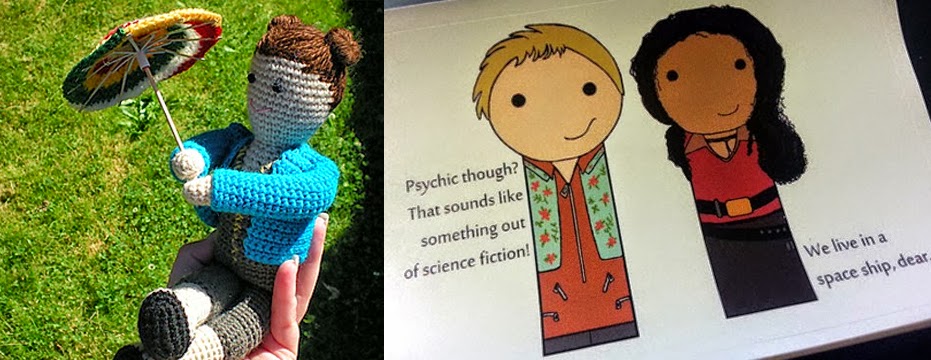
Yesterday was my birthday, and it was full of all kinds of fun. After a nice hike with friends and games in the evening, we settled in for a visit with my friends aboard Serenity. So, staying with that theme, here are some really cool Firefly/Serenity inspired crafts!


I love love love this little crochet Kaylee doll by Nancy Torrance over on Ravelry! She's so cute! And the parasol! So perfect!


This knit Blue Sun bag by Aliese Holder on Ravelry is perfect for carrying your stuff when you're off on your daily adventures.


I have been obsessed with painted shoes lately. And these Serenity shoes by Christine Hutton at Scrapcrafter are really gorgeous.


Everyone else seems to be obsessed with peg people. And I can understand why. Look at how cute Zoe and Wash look as peg people in this print by Jen at Mimi & Boo!


I have already added the entire set of these Firefly crew felt pillows by Telah McClary at Heart Felt Design to my wish list for next year. No geeky couch should be without them!

Friday, November 22, 2013

Happy Birthday Mary of Guise

Mary of Guise (22 November 1515 – 11 June 1560)

Mary of Guise was queen of Scotland as the second wife of King James V. She was the mother of Mary, Queen of Scots, and served as regent of Scotland in her daughter's name from 1554 to 1560.

In 1537 Mary became the focus of marriage negotiations with James V of Scotland, who wanted a second French bride to reinforce the Franco-Scottish alliance against England. This wasn't her only option for her own second marriage (her first husband died early). The recently widowed Henry VIII of England, who was looking for another wife himself, but who also wanted to prevent this union, also asked for Mary's hand. It's not surprise that given Henry's marital history Mary refused the offer. Henry VIII told the French ambassador to London that he was big in person and had need of a big wife. It is said Mary replied, "I may be a big woman, but I have a very little neck."

The marriage contract was finalized in January 1538. On 18 May 1538, at Notre-Dame de Paris, James V and Mary of Guise were married with Lord Maxwell acting as proxy. She arrived in Scotland on June 10 and was formally received by James. They were married in person a few days later at St Andrews. Margaret Tudor, James's mother, wrote to Henry VIII saying, "I trust she will prove a wise Princess. I have been much in her company, and she bears herself very honourably to me, with very good entertaining."

On February 22, 1540, she was crowned queen. James and Mary had two sons. James Stewart, Duke of Rothesay, was born May 22, 1540. Robert was born and baptised on April 12, 1541, but tragically both died on April 21, 1541. Their third child was Mary, born on December 8, 1542. Sadly, King James died six days later, leaving the infant Mary as queen regnant of Scotland.

Seeing an opportunity to gain control over Scotland, Henry VIII of England wanted to organized a marriage between baby Mary and his son, Prince Edward. This led to political conflict in Scotland between those who wanted the marriage and those who wanted to remain aligned with France. This led to an English invasion, what was known as the Rough Wooing, and increased sparring between the two countries. After a Scottish defeat at the Battle of Pinkie Cleugh in September 1547, increased French military aid weakened the position of the English, and increased the power of Mary of Guise and her supporters.
At this time, the dedication of the Scottish book, The Complaynt of Scotland, recalled Mary of Guise's descent from Godfrey de Bouillon and claimed her courage and virtue exceeded those of the ancient heroines Tomyris, Semiramis and Penthesilea.
Mary became regent on April 12, 1554 and quickly stepped into her new role, dealing effectively with Scottish affairs, traveling around Scotland handling many long-standing domestic disputes. As Protestantism began to spread throughout Scotland, though, her power began to wane. And the continuing discord between England and Scotland began to worsen as Elizabeth I took the throne.

While fortifying Edinburgh Castle, Mary became seriously ill, and over the course of the next eight days her mind began to wander; some days she could not even speak. On June 8, 1560 she made her will. She died of dropsy on June 11.

(source: Wikipedia)

Tuesday, October 15, 2013

Music Break - Victoria Spivey

Today's special birthday shout-out goes to the amazing Victoria Spivey, born on October 15, 1906. This lady was seriously kickass, all the way through her long and productive life.


Victoria Spivey was born into a family chock full of musical talent. Her father, employed as a railroad flagman, was also a part-time musician. Her mother was a nurse (I promise a longer post some day about African American women nurses around the turn of the last century -- it's a fascinating story!). And all three of her sisters were musicians.

Together, they formed a family string band, and performed around Houston, Texas. Sadly, her father died when she was only 7 years old, leaving her to find her way in the music business without him. As it turns out, she did quite well. Even as a child, she continued to perform at local parties, and at the age of 12 was hired to accompany films at the Lincoln Theater in Dallas.

All through her teen years, she worked in local bars, nightclubs, and buffet flats, learning and growing musically. She usually performed solo, but occasionally with other, more experienced singers and guitarists.

At the age of 19, she moved to St. Louis. It was there where she began her recording career. Her first song, "Black Snake Blues" was a success, followed by other songs that were equally well received. Because of her experience working in some of the shadier parts of town and hanging out with prostitutes and drug addicts, many of these characters and themes found their way into her music.
In the early '20s, she played in gambling parlors, gay hangouts, and brothels in Galveston and Houston with Blind Lemon Jefferson. Among Spivey's many influences was Ida Cox, herself a sassy blues woman, and taking her cue from Cox, Spivey wrote and recorded tunes like "TB Blues," "Dope Head Blues," and "Organ Grinder Blues." Spivey's other influences included Bobby "Blue" Bland, Sara Martin, and Bessie Smith. Like so many other women blues singers who had their heyday in the '20s and '30s, Spivey wasn't afraid to sing sexually suggestive lyrics, and this turned out to be a blessing nearly 40 years later given the sexual revolution of the '60s and early '70s.
(source: AllMusic.com)
By 1929, she was well known in the blues community, and was given the role of Missy Rose in the all black musical film Hallelujah directed by King Vidor. Even during the Great Depression, she was busy performing, touring and recording with many famous musicians of the era, including Louis Armstrong, as well as appearing in other films and musical reviews.

For a brief period in the 1950s, she was considered semi-retired. Even then her incredible musical talent was still a big part of her life, and she spent these years as choir director and pipe organist in her church. But when the folk music revival started in the early 1960s, she felt called back to secular music. This time, she was not only performing, but leading the charge to find and support new musicians as well as bring attention to other, lesser-known musicians from the past.
After taking a semi-retirement in the 1950s, Spivey returned to performing in the United States and internationally in Europe and in 1962 began her own record company, Spivey Records. She used this company as a vehicle to resurrect older blues artists as well as introduce new artists, including Luther Johnson, Lucille Span, Olive Brown, and the first recording of folk artist Bob Dylan. She also recorded some of her own music during this period and occasionally performed on television. By the time of her death in 1976 she had attained copyrights on the lyrics of at least seventy-five songs.
(source: Emory University)
Her immense talent and staying-power is truly remarkable.
Victoria Spivey was one of the more influential blues women simply because she was around long enough to influence legions of younger women and men who rediscovered blues music during the mid-'60s U.S. blues revival, which had been brought about by British blues bands as well as their American counterparts, like Paul Butterfield and Elvin Bishop. Spivey could do it all: she wrote songs, sang them well, and accompanied herself on piano and organ, and occasionally ukulele.
(source: AllMusic.com)
This is certainly one kickass blues lady who deserves plenty more attention!


If you like the work I do here at Self-Rescuing Princess Society,
please check out my Patreon.


For more information:

The Blues Trail - Victoria Spivey
Smithsonian Folkways
The Blindman's Blues Forum


You may also be interested in:

SRPS Shout-Out - Althea Gibson
"Shaking hands with the Queen of England was a long way from being forced to sit in the colored section of the bus going into downtown Wilmington, North Carolina." "I want the public to remember me as they knew me: athletic, smart, and healthy.... Remember me strong and tough and quick, fleet of foot and tenacious."
Eliza Ann Grier - the first black woman to receive a MD in Georgia
Very little is known about her early life. She was born during the Civil War. Her parents were slaves in Mecklenburg County, North Carolina, which made her a slave as well. After emancipation, her family moved to Atlanta, where she grew up and attended school. She originally intended to become a teacher, and attended Fisk University.
Josephine Groves Holloway - A True Girl Scout
One such devoted Girl Scout leader was Josephine Groves Holloway. In 1923, Josephine, the daughter of a Methodist minister and a recent graduate from Fisk University with a degree in sociology, was working as a social worker for the Bethlehem Center in Nashville, Tennessee, a Methodist-run family resource center serving the black community.


Sunday, August 25, 2013

Happy Birthday - Lavinia Fontana

Lavinia Fontana was born August 24, 1552, in Bologna, Italy.

Lavinia Fontana, 1552-1614, Bolognese Painter
by Felice Antonio Casone ca. 1611 (source: Wikipedia)


Lavinia Fontana was one of the most successful painters in her time, and the highest rated female painter in Bologna. Unlike the few other women artists at the time, she had a prolifically successful career painting a wide range of subjects for her patrons and clients -- including portraits, alterpieces and historical and mythological paintings.

While it wasn't totally uncommon for noblewomen to explore artistic pursuits, the level of training and support, as well as the number and types of commissions she received during her career, are remarkable. It was a lucky accident that she was born into the family and time she was. Her father, Prospero Fontana, was himself an accomplished and well respected artist of his time. He taught his daughter and treated her as an apprentice in the family business of painting, which was customary at the time.

Self-portrait at the Clavichord with a Servant ca. 1577 (source: Wikipedia)


In addition to having a master as a father and mentor, she was born during an exciting time for art in Bologna. The city was considered one of the greatest cities for painters at the time. She was surrounded by great artists and art, and there is no doubt that the social and religious culture of Bologna had a profound effect on her as an artist.
Being born the daughter of the successful artist Prospero Fontana (1512-1597), a provincial painter with a solid reputation, had numerous advantages. During Lavinia's apprenticeship, Prospero shared with his daughter the artistic skills he had mastered during his early training in Genoa. The time Prospero had spent working in Florence and Rome, prior to returning to Bologna, undoubtedly contributed to the overall quality of Lavinia's early studies. Lavinia's apprenticeship in her father's studio provided her with ample opportunities to contribute to her father's commissioned works as well as to produce works of her own design. The first recorded works attributed to the hand of Lavinia date from 1575. Lavinia also profited from being born in the Italian city--state of Bologna, which was a prominent Italian artistic center during her lifetime. In Bologna, Lavinia could study distinguished works of art at her convenience.
(source: Extraordinary Women of the Medieval and Renaissance World: A Biographical Dictionary, by Carole Levin; Debra Barrett-Graves et al.)
Under her father's tutelage she developed her natural talent and became a prosperous portrait painter. At the time, most women painters worked solely selling their skills painting portraits of wealthy families, and particularly women nobility. Her attention to detail and her genuine talent brought her widespread fame, reaching beyond Italy.

Portrait of a Noblewoman ca. 1580 (source: NMWA)


When she was twenty-five, she married another young student of her father, Paolo Zappi. She and Paolo had 11 children, only three of whom survived her. Although Paolo was also a painter, it appears that his role in the marriage was more one of support for his wife's artistic career. He acted as her assistant, which included painting minor elements of her works.

Her commercial painting included more than just portraits. She also painted devotional images and alterpieces.
Fontana was also the first woman to paint alterpieces at the time of Counter-Reformation and the growing power of the Catholic Church. One of her altarpiece paintings, San Francisco di Paola blessing the Child has been also on view in the Pinacoteca Nazionale. Birth of the Virgin Mary can be seen in Santissima Trinita church and Madonna Enthroned with Child and Santa Caterina of Alexandria, Cosma, Damiano e il Committente Scipione Calcina in the church of San Giacomo Maggiore, among other churches of Bologna.
(source: Women In The Arts)
Judith with the Head of Holofernes ca. 1570 (source: It's About Time)


Her fame attracted the attention of high ranking members of the Catholic Church, and she was increasingly commissioned for portraits and works with a religious theme.
National Gallery of Art Fontana and her family moved to Rome in 1603 at the invitation of Pope Clement VIII. She gained the patronage of the Buoncompagni, of which Pope Gregory XIII was a member. Lavinia thrived in Rome as she had in Bologna and Pope Paul V himself was among her sitters. She was the recipient of numerous honors, including a bronze portrait medallion cast in 1611 by sculptor and architect Felice Antonio Casoni.
(source: Wikipedia)
There are quite a few great resources online and in print if you're interested in learning more about the life and works of Lavinia Fontana:

Wednesday, August 21, 2013

Duchess Sophie-Elisabeth of Mecklenburg

Four hundred years ago, Duchess Sophie-Elisabeth of Mecklenburg was born into a life of immense wealth and privilege. But even as a noble woman her options for a fulfilling life were limited. With the support of her family she was able to build on her innate musical talents and produce many projects which have been remarkably well preserved as an example of early baroque compositions.

She was born on August 20th in 1613, into a wealthy family with a long history of supporting the arts. While it was not unusual for girls of her status to be given a basic education in language and culture, her experience was more than simply learning how to appreciate fine art and music. She was afforded the remarkable luxury of being able to study with many distinguished musicians, and eventually given the opportunity to become an important figure in the German baroque movement.
"At Güstrow, Sophie-Elisabeth's father maintained a thriving musical establishment, with a sizable contingent of English virtuoso performers in its orchestra. Sophie-Elisabeth and her sister Christine Margarete thus had rich opportunities to study the lute and gamba."
Her mother, a remarkable musical talent herself, died while Sophie-Elisabeth was still quite young. Her father soon remarried, and his second wife, Elisabeth, was an extraordinarily gifted musician and singer as well. In addition, she was fluent in several languages, as well as educated in theology.
"Following her personal convictions, Elisabeth of Hesse-Kassel involved herself directly for nine years in the education, including religious and musical tutoring, of the young Sophie-Elisabeth and her sister. Elisabeth's upbringing amid the intense musical activities and her father's court prepared her to be duchess at Güstrow, expanding its instrumental forces and actively encouraging festive court representations. Thus as a teacher and active musical administrator, she acted as an influential role model for her young charges at Güstrow. With adulthood, Sophie-Elisabeth would follow Elisabeth's example as an important musical impresario."
Tragically, when Sophie-Elisabeth was 13, Elisabeth, only 29 herself, died, leaving her father widowed and his children motherless for a second time. Proving the importance placed on music and arts training in the Güstrow estate, his third wife, Eleonore Marie, was also a well-educated woman, with a strong background in religion, languages, and especially music. She took over the continued education of Sophie-Elisabeth and Christine Margarete.

Only two years later in 1628, the whole family was forced to flee their home and homeland of Mecklenburg as exiles as the political and religious turmoil of the Thirty Years' War spread to the region. Sophie-Elisabeth and her sister spent the years at the Kassel court with the father of their former step-mother Elisabeth. While this experience must have been stressful for two young women in their formative teenage years, it was also likely a highly influential experience on Sophie-Elisabeth's musical experience, as the Kassel court had a "long and distinguished musical history." Her step-grandfather himself was an educated musician as well as a patron of the arts, and regularly hosted musical events as well as fostered a general atmosphere of refined culture.

After the family estate was liberated, Sophie-Elisabeth and her family returned to Mecklenburg, and slowly resumed their lives of luxury and study. In 1635, at the age of 22, Sophie-Elisabeth married Duke August the Younger of BraunschweigLüneburg, himself a highly educated man and patron of the arts.

The Thirty Years' War continued to rage in her homeland, Sophie-Elisabeth and her husband Duke August and his children were somewhat protected, and continued to participate in an active cultural life.
"Sophie-Elisabeth's humanist background fit in perfectly with the Wolfenbüttel court, a sophisticated center of German intellectuals and literati. She participated in several of Wolfenbüttel's exclusive literary-arts societies that she had joined early in her marriage: the Académie des Loyales, the Tugendliche Gesellschaft, and the Fruchtbringende Gesellschaft, in which she was given the pseudonyms die Fortbringende, die Gutfillige, and die Befreiende, respectively. Dedicated to the cultivation of works in the German language, Wolfenbüttel's Fruchtbringende Gesellschaft, however, offered full membership only to men. But with her status as Duke August's wife, Sophie-Elisabeth was thus admitted as an honorary member, one of the earliest women accepted into this society. Her participation in these organizations contributed significantly toward maintaining the Wolfenbüttel court as a major center of contemporary German and French literature."
Her marriage to the Duke gave her a rich cultural experience, and contributed to the expanding of the arts throughout Europe, despite the continued ravages of the war. While acting as a mother to the Duke's four children, as well as raising her own two children, she also managed much of the cultural events at court. By 1645 her husband was so busy with political duties he officially made her the administrator of the musical events of his court. She was tasked with the management of the musicians and structuring of the musical establishment. This duty sometimes even meant reprimanding her husband for failure to pay his court musicians.

It was during this time that she collaborated with Heinrich Schütz, an established composer affiliated with the nearby Dresden court. He acted as her mentor in the reorganization of the musical events at her husband's court, as well as helping her with her own musical compositions. With his assistance she was able to restructure the musical life at court after the chaos of the war.
"Sophie-Elisabeth -- because she was a woman -- never had been able to undertake the rigorous formal course of study, particularly in counterpoint, traditionally required of 'professional' male students for composing unaccompanied choral works." Schütz offered her suggestions for improvement and encouragement in her talents. In 1661, he wrote to her husband, praising her "as the incomparably perfect princess in all other princely virtues, especially in the praiseworthy profession of music."
"The earliest surviving collections of Sophie-Elisabeth's musical works and arrangements appear in three sizable manuscript collections now in Wolfenbüttel's Herzon-August-Bibliothek, the distinguished library founded by her husband."
Each of the three manuscript collection contains works of a similar type and period in her development, and document her improvement over time. Additionally, there are two songbook collections of works Sophie-Elisabeth created with her husband.

In her role as administrator of the musical events at court, she was involved in creating and producing twenty-five Festspiele -- "song-ballets, each one consisting of a series of dances with much vocal music embellishing the drama itself."  Not only did she organize these events, she also composed or arranged much of the music for them.
"Although twice left motherless in her childhood and subjected to the horrors and indignities of a terrible was, Sophie-Elisabeth transcended the typically circumscribed orbit of a female royal spouse in her day with its rather fixed cultural and gender roles. To the contrary, this musically gifted, persevering, compassionate, and politically astute duchess contributed significantly to the cultural history of the German early baroque period."
"Among the relatively few seventeenth-century German noblewomen composers of her day, Sophie-Elisabeth was also the first German woman composer to attain performances and publication of her works while she was living. That was no small feat."
While she may not have been up to the standards of many of her contemporary male composers, it is clear that she was quite talented and that this talent had been supported by her father and her husband, which in itself is quite remarkable. Her strength as a woman who had to overcome the hardships of life and war is evident in her quite capable handling of court affairs as duchess. That so many of her works have been preserved shows that she was a valued member of the court. She clearly deserves to be remembered as a talented and capable musician in her own right.

text source: Five Lives in Music: Women Performers, Composers, and Impresarios from the Baroque to the Present by Cecelia Hopkins Porter)

photo source: RoyaltyGuide.nl

Tuesday, March 12, 2013

Happy Birthday - Dr. Dorrit Hoffleit

"All the hardships taught me something, and they taught me how to cope. So, I was prepared to fight back. If it had all been good, I wouldn’t have known how to fight."
Ellen Dorrit Hoffleit was born on March 12, 1907, in Florence, Alabama, but the family soon moved to Newcastle, Pennsylvania.


Her interest in astronomy started quite early, when she watched the Perseid meteor shower with her family.
"My mother and brother and I used to sit in the backyard, especially during the Perseid meteor showers, and look for meteors," she said. "What impressed me was the sheer beauty of the event."
The family moved to Cambridge, Mass., so that her brother could attend Harvard College. She graduated from Radcliffe College but never seriously considered astronomy until she got a job in 1929 working for noted astronomer Harlow Shapley at the Harvard College Observatory. 
Hoffleit described herself as no better than an average undergraduate, but she showed a zeal for examining Harvard's vast collection of photographic plates of the skies. In her spare time, she wrote a paper on meteors and dropped it on Shapley's desk. Shapley was so impressed that he encouraged her to pursue a Ph.D. 
"I have never been as happy as that day," she said.  
(source: Hartford Courant
During World War II, she went to work at the Aberdeen Proving Ground ballistics laboratory in Maryland. Not unlike many women working for the war effort, she was forced to take a position below her status while she watched men who had less experience take higher level jobs. Frustrated that women weren't getting the training they needed and the promotions they deserved because of a fear that they would "run off and get married," she complained to a visiting inspector general, who helped improve the situation and get them the professional ratings they were entitled to.


She returned to the Harvard Observatory but didn't stay long. When Harlow Shapley retired, he was replaced with someone who did not appreciate her research, and even went so far as to have one-third of the photographic plates destroyed. It broke her heart to leave, but she could not stay under those conditions.
Dorrit went job hunting, and, when the dust had finally settled, she was ensconced in two positions that she would occupy officially for the next twenty years (and unofficially long beyond that). It was in those two contexts that most of us came to know her. Hoffleit became, half-and-half, both director of the Maria Mitchell Observatory from 1957 to 1978 and a research astronomer at Yale (1956 to official 1975 retirement) under its long-term director Dirk Brouwer, where her primary task was to be preparation of astrometric catalogs.  
(source: Bulletin of the American Astronomical Society
In 1956, she took a position at Yale, and in 1957 began spending the summers on Nantucket, teaching programs at the Maria Mitchell Observatory, named after the first female American astronomer Maria Mitchell. Over the years she taught there, she worked with young students, mostly women who became known as the "Girls."


While at Yale, Hoffleit taught the most basic course on Astronomy to Undergraduates. Her passion for the subject was inspiring to these young men and women who were probably only in the class to fulfill a GE requirement. She retired from teaching in1975, but continued to work until her death in 2007, at the age of 100.

Most notably, she was the author and editor of several editions of the Bright Star Catalogue, an extensive compilation that lists all the stars visible with the naked eye from Earth. She also co-authored The General Catalogue of Trigonometric Stellar Parallaxes, which contains precise distance measurements to nearly 9000 stars, information critical to understanding the history and workings of our solar region.


In 1988, she was awarded the George Van Biesbroeck Prize by the American Astronomical Society for her lifelong contributions to astronomy. In 1993, she was the second astronomer to receive AAS-Annenberg Prize for science education. The first recipient was Carl Sagan.

Among her many other awards and recognitions, she served as a past president of the American Association of Variable Star Observers; a Hoffleit Assistantship was established at the Mitchell Observatory; and asteroid 3416 Dorrit was named after her.


Happy Birthday, Dorrit!

If you like the work I do here on SRPS, please support me!


More Reading: