Kickass Women

History is filled with women doing all kinds of kickass stuff.

Smart Girls

Watch these girls... they're going places!

Inspiration

Need a dose of inspiration? Here you go.

SRPS Entertainment

Some of my entertainment recommendations with awesome female characters and stars.

She's Crafty!

Some of the awesome items made by kickass women!

Wednesday, July 18, 2012

Happy Birthday Elizabeth McGovern

We all know and love her in the role of the inimitable Countess Cora Grantham, doling out advice to her stubborn husband and feisty daughters, while artfully dodging the barbs thrown her way by her deliciously spiteful mother-in-law.


Did you know she's also a musician? She is considering taking some time off from acting to tour with her band, Sadie and the Hotheads.


Not too shabby!


Happy Birthday Elizabeth McGovern!

SRPS Shout Out - Nadia Comăneci

"I don't run away from a challenge because I am afraid. Instead, I run toward it because the only way to escape fear is to trample it beneath your feet."
On this day in 1976, Nadia Comăneci was the first female gymnast to be awarded a perfect 10 in an Olympic event. Her story was something I grew up with just knowing. I was six that year, and probably watched the Olympics, although I don't really have any clear memories of it.


Rewatching the video now, I'm struck by her grace, her poise, her calm confidence. While I have never been a gymnast myself, I have always admired the sheer athleticism required.


Throughout the 1976 Olympic, Nadia earned seven perfect 10 scores, and her opponent Nellie Kim earned two.

Although retired from competing, she has remained active in the world of gymnastics. While she was living in Romania, she worked with their national junior gymnastics program. Romania at this time was  run by an oppressive regime, and there were many defections during the 80s. Nadia was closely guarded, and it wasn't until the late-80s that she was able to escape. She made her way to the U.S. and then to Canada. There was some drama around her relationship with the man who helped her escape, and some concerns that he was controlling and possibly abusing her. With the help of her former coach, the infamous Bela Károlyi, she was able to get away from him.

In 1996, she married American gymnast Bart Conner, and the couple now has a son. Since the fall of communism, she has returned to Romania several times, and has set up several charity organizations, as well as taking a leadership role in the national gymnastics program.
"I believe that you should gravitate to people who are doing productive and positive things with their lives."
In the U.S., she was invited to be a speaker at the U.N., and is the current president of the Special Olympics. In the past, she has been hired as a color commentator for gymnastic events, and I sincerely hope she is invited to the 2012 Olympics in London next month.

I can't do the work of SRPS without your your support!
If you like what you read here, please share this post with your friends.

Tuesday, July 17, 2012

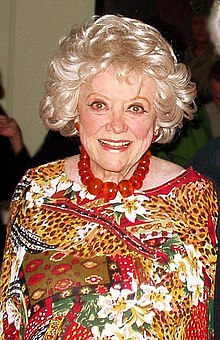
Happy Birthday Phyllis Diller

Phyllis Diller is 95 today!


I have always loved Phyllis Diller. I grew up with her all over the TV and late night shows. Her comedy was genius -- always making fun of herself, her husband "Fang," and generally taking pot shots at social beauty norms.


Her jokes might seem to be regressive on the surface, but they're really quite subversive. Like Erma Bombeck and, later, Roseanne, she reveled in her supposed inability to be the perfect house wife.
Cleaning your house while your kids are still growing up is like shoveling the walk before it stops snowing.

It's this kind of humor that helped to take the pressure off many women during the 60s and 70s, and even 80s, letting them laugh at their so-called short-comings.
Housework can't kill you, but why take a chance?
And instead of working hard to fit the beauty standards of the day, she went in the opposite direction. It's the classic I know you're going to laugh at me, so I'll really give you something to laugh at approach.


As a child, I loved her wacky sense of humor. I always loved seeing adults breaking the social norms. And Phyllis broke them all to teeny tiny pieces. I still remember her appearance on The Muppet Show.

As an adult, I love how she busted up the notion of how older women were supposed to act or look. By the time I "met" her in the 70s, she was already in her late-50s and early-60s. I love that she's loud, she takes up space, she isn't grandmotherly or dottering. It's like she became my internalized version of me at that age. Well, without the pink and yellow feather dress, of course.

Happy Birthday, Phyllis!

SRPS TV Night - British women make great detectives!

I have been watching lots of TV series on Netflix on the PS3. It's pretty cool how as soon as I finish a series, the Netflix app gives me three suggestions based on what I just watched. I can chain shows pretty easily, without having to do any searching.

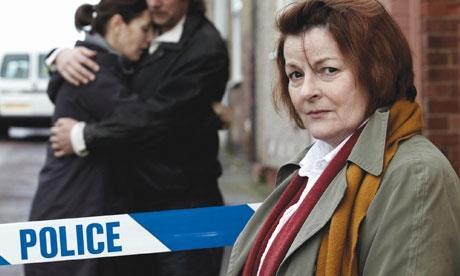
One show I watched recently was Vera. Just seeing the cover, I know it's got Brenda Blethyn, one of my favorites. You may recognize her as Mrs. Bennett from the Pride and Prejudice movie with Keira Knightly, or as the mother from Secrets and Lies, or as the widow in Saving Grace. All three are great SRPS movies.  So, already I knew this was going to be a great SRPS television series. Also, interestingly, she was in a movie entitled The Witches with Anjelica Huston.


I was not disappointed one bit. Well, I was disappointed with the fact that there are so few episodes, but as any BBC series fan knows, that's the price we pay for excellent stories.

Based on the heroine of Ann Cleeves series, Vera is like a kind-but-tough country grandma-turned-police detective. Not exactly a Columbo-type, though. She's not exactly self-deprecating. She's tough. She'll yell and put the fear of God into her staff when she needs to. But she's also kind and clearly a caring member of her local community. Or, as Brenda Blethyn says of her character:
"She's kind of like an ordinary person really. If you sat next to her on the bus and struck up a conversation you'd probably be talking about the two-for-one pries down at the Co-op."

Only season 1 is available on Netflix at this time. One of my favorite episodes is about a murder associated with a controversial quarry project. It's not just the story, but the great roles and performances for everyone involved. The characters are well-developed, complex people with mixed desires. I cannot wait to get my hands on season 2. It has immediately been added to my wish list.

Once I was finished with Vera, Netflix suggested Blue Murder. I have to admit I was a teeny bit skeptical after watching the first 10 minutes. The production values are very different, and not only because the show is a few years older. But I was also intrigued by the premise of a single mother trying to handle raising her children, who is also pregnant, serving as a detective.


In season 1, one of my most favorite storyline was between Janine and her neighbor and friend, Leslie. It's just the real-kind of friendship you'd expect between friendly neighbors helping each other out.

While Vera never really delved into Vera's private life, Blue Murder spends a good amount of time showing us Janine's personal struggles and accomplishments as well as her detective work. And I think that's what I like the most about this show. The investigations are exciting, and usually involve some kind of clever twist, but it's nice to see how Janine juggles her personal responsibilities as a single mother, handling issues with her children and her estranged husband, exploring romantic possibilities, and just trying to keep everything together.

While the series ran for five seasons, from 2003 to 2009, Netflix only has seasons 1 and 2. You can be certain I'll be searching out the last three seasons.

Monday, July 16, 2012

Happy Birthday Ida B. Wells

Ida B. Wells Barnett was born on July 16, 1862 in Holly Springs, Mississippi. She started out as a slave, but after emancipation she spent her life working to raise the status of her people, and to spread the truth about what was happening to them. Her work as a writer, reporter, and editor helped spread the hope of truth and empowerment far and wide.
The way to right wrongs is to turn the light of truth upon them.

Our country's national crime is lynching. It is not the creature of an hour, the sudden outburst of uncontrolled fury, or the unspeakable brutality of an insane mob.

The negro has suffered far more from the commission of this crime against the women of his race by white men than the white race has ever suffered through his crimes.

The people must know before they can act, and there is no educator to compare with the press.

Thus lynch law held sway in the far West until civilization spread into the Territories and the orderly processes of law took its place. The emergency no longer existing, lynching gradually disappeared from the West.

What becomes a crime deserving capital punishment when the tables are turned is a matter of small moment when the negro woman is the accusing party.

Somebody must show that the Afro-American race is more sinned against than sinning, and it seems to have fallen upon me to do so.

SRPS Shout Out - Dr. Emily Stowe

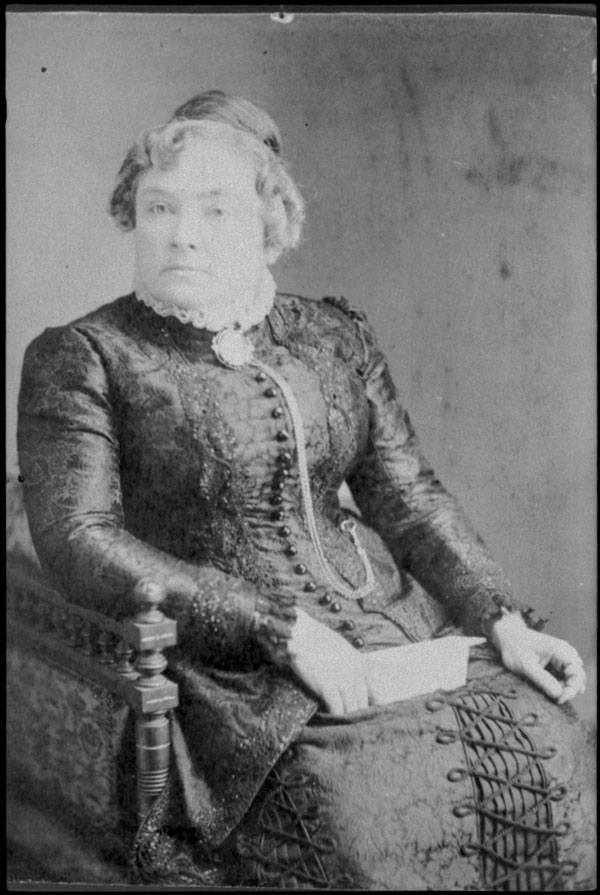
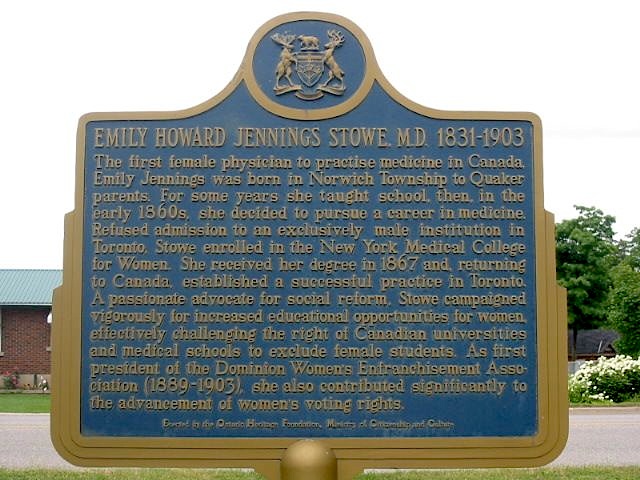
On July 16, 1880, Emily Howard Stowe, a life long suffragist and woman's rights activist, became the first female physician to practice in Canada.


Emily Howard Jennings was born in 1831 on a farm in Norwich Township in Upper Canada (now Ontario), the first of six daughters of a Methodist father and a Quaker mother. Emily's mother had been well-educated at an American Quaker seminary and believed in a good education for her daughters. She was so dissatisfied with the local schools that she chose to instruct all her children herself.
At age 15, Emily became a teacher in a one-room schoolhouse in neighbouring Summerville, where she taught for seven years. Her struggle to achieve equal opportunities for women began in 1852 when she applied for admission to Victoria College, in Cobourg, but was refused because she was female. She was, however, accepted by Toronto’s Normal School for Upper Canada, the only advanced school open to women in British North America. She graduated with first-class honors in 1854. 

She took a teaching position at the Brantford School Board, and quickly moved up to become the first woman principal of a public school in Upper Canada. After she married John Stowe, they moved to Pleasantville and started a family.
Soon after the birth of John and Emily Stowe's third child, John contracted tuberculosis. His illness inspired Emily to explore the field of herbal healing and homeopathic medicine, an area her mother had studied. This, together with what she saw as a serious need for women doctors, led to her decision to become a physician.
In 1865, Emily Stowe applied to the Toronto School of Medicine, but once again, she was denied admission. "The doors of the University are not open to women and I trust they never will be," the University's vice-president told her. Stowe was outraged. She promised herself that she would do everything possible to enable women to have the same opportunities as men. Unable to study in Canada, she moved to the United States and enrolled at the New York Medical College for Women, a homeopathic institution in the city of New York. She obtained her degree in 1867 and returned to Canada and set up a practice in homeopathic medicine on Richmond Street in Toronto, even before obtaining her license. She thus became the first practising female physician in Canada.

Even after she received her degree in the US, she was not allowed to enter the University of Toronto, until 1871. And then only with a special arrangement to allow her and another woman, Jenny Trout, to attend the lectures.
It was a difficult period for both of these women, since students and faculty went out of their way to humiliate them. Dr. Stowe either failed her exams or defiantly refused to sit them and returned to her practice, still without a licence. Jenny Trout passed her exams and became the first licensed female physician in Canada.

Her work to be accepted into the medical profession, reinforced her feminist ideals. She continued to fight for the rights of women throughout her life. In 1877, she helped to found the Toronto Women's Literary Guild, a suffragette group with the aim of improving women's working conditions. The group work hard to open up higher education opportunities for women in Toronto, and they succeeded. In 1883, their name was changed to the Canadian Women's Suffrage Association, and their reach was extended to all of Canada.
Meanwhile, Dr. Stowe continued her medical practice, specializing in women and children and giving lectures on women's health. In 1879, she was charged with performing an abortion on one of her patients. She faced a long and intimidating trial during which her qualifications were scrutinized and members of Toronto's medical establishment were called to bear witness to her character, skill and professional conduct. In the end, she was acquitted.
The next year, she was finally granted her medical licence by the College of Physicians and Surgeons of Ontario, making her the second licensed female physician in Canada.

She continued to fight for the rights of women to pursue the medical profession. She worked tirelessly to convince the University of Toronto to reverse its policy and allow women into their program. In fact, perhaps her proudest moment in life can in 1883 when her own daughter, Augusta Stowe-Gullen, was the first women doctor to graduate from a Canadian medical school.
The same year that Dr. Stowe's daughter graduated from medical school, a public meeting of the Toronto Women's Suffrage Association, with Dr. Stowe at the forefront, led to the creation of the Ontario Medical College for Women.
In 1888, Dr. Stowe attended an international conference of suffragettes in Washington, D.C. She returned home to revitalize the women's movement in Canada and continued the fight to win the vote for women. Her vehicle was the Dominion Women's Enfranchisement Association, which she founded in 1889. She became its first president and held the position until her death.
(source: Library and Archives Canada)

Happy Birthday Ginger Rogers

Ginger Rogers would have been a graceful and glamourous 101 years old today.
My mother told me I was dancing before I was born. She could feel my toes tapping wildly inside her for months.
The only way to enjoy anything in this life is to earn it first.

While looking for a great video of her with Fred Astair, I came across this great video of her dancing the salsa at the age of 92. Amazing!


Wow! That's incredible! What an artist! What a class act!

SRPS Move Night - Sarah's Key


Seventy years ago, July 16, 1942, in German-occupied France, the Nazis began a mass roundup of Jews. It was the first of such roundups in France.
The Vel' d'Hiv Roundup was a Nazi decreed raid and mass arrest in Paris by the French police on 16 and 17 July 1942, code named Opération Vent printanier ("Operation Spring Breeze"). The name for the event is derived from the nickname of the Vélodrome d'Hiver ("Winter Velodrome"), a bicycle velodrome and stadium where many of the victims were temporarily confined. The roundup was one of several aimed at reducing the Jewish population in occupied France. According to records of the Préfecture de Police, 13,152 victims were arrested and held at the Vélodrome d'Hiver and the Drancy internment camp nearby, then shipped by railway transports to Auschwitz for extermination.
(Source: Wikipedia) 
Late last week, before I had heard about the Vel' d'Hiv Roundup, I was scanning films on Netflix under the Strong Female Lead heading, and came across a movie that looked intriguing.

Sarah's Key is a look at how the past and the present often get tangled up together, by juxtaposing the story of Sarah, a jewish child in Nazi-occupied Paris, and Julia, an American journalist whose husband's family inherits the same apartment.

The film opens with the joyful, innocent laughter of Sarah and her brother Michel tickling each other under the blankets in their parents' bed. But their giggles are interrupted by an ominous knocking at the door. To protect her brother, because she knows that the Nazis have been rounding up men and boys, she locks in him the little closet and makes him promise to stay in there and stay quiet until she opens it up.

This scene is followed by a view of the same apartment, in the present with Julia and her husband and teenaged daughter walking through and talking about remodeling.


Julia is an American journalist working for an International magazine, and is interested in doing a story about the upcoming anniversary of the Vel' d'Hiv Roundup. During her investigations, she learns that not only was the neighborhood where her new apartment is located the former Jewish district, but that her apartment in particular had been purchased by her husband's family just weeks after the roundup. She begins to dig deeper, following leads to track down Sarah and find out what happened to her and her family. At one point, she interviews a man who has studied that period extensively, and asks about the conditions in the velodrome during the roundup. He tells her, "Imagine the Superdome after Katrina, only time ten."


Sarah is a vivacious, brave girl facing unimaginable terror and showing amazing strength during the roundup, as the gendarmes show up pounding on the door of their flat, during their horrific time in the velodrome, and later when she is separated from her family in the concentration camps. All the while, she is obsessed with getting back to Paris and letting her brother out of the closet. 

While they are in the velodrome, she gets very sick, like many of the other people confined. By the time they reach the camp, she and her mother have already been separated from her father. In a particularly gut-wrenching scene, the mothers are now separated from their children. Sarah is very sick, and her mother's goodbye is very sweet and very sad. 

But that's not the end of the story. Sarah gets better, and befriends another girl. Together, they escape. They make their way to a nearby farm house where an older Christian couple take them in. I don't want to spoil any of the movie for you, though, so I'll leave off there.

I was immediately drawn into the story. Here's a girl fighting the system to save her brother, and a woman fighting to learn the truth about what happened in her family's past. It's a compelling story. How do we make up for the damages done in the past that we benefit from now? How do we live with the knowledge that our current privileges are at the expense of others?

All of the women and girls in this story are strong and do not shrink away from danger. There are some really fabulous glimpses of women doing whatever they can to survive, women holding up under pressure, women getting on with the business of living.

Yes, this film qualifies as a Self-Rescuing Princess Society film. I highly recommend it.

If you like the work I do here on SRPS, please support me!


You may also be interested in:

Another Double Hitter: Movie Review & Shout-out
I would have loved to have known about Doris Sams and the other professional womens baseball players when I was a girl! No telling how I would have used that info. I wasn't especially athletically inclined, but it certainly would have been inspirational anyway. I'm sure I would have devoured biographies about women ball players if I had found any, the same way I read through every book I could find on Amelia Earhart.

Movie Night - The Iron Lady
My more careful thoughts about the movie are a bit more complicated. It's not that I didn't enjoy the movie. I did. I liked the story. I liked the mixing of modern times in with history, and the mix of political with personal. I liked seeing the whole life of such a strong woman who influenced history. We see her as young woman starting out with passion and verve, and as a middle-aged woman learning how to appreciate her power and seeking to use it to actually do something in life.

Movie Night - Advantageous
The decision to live as a single mother in this world was a dangerous one, she knew, but she also hoped it would give her life meaning; make it worthwhile. And, in its own way, her ultimate decision simply confirms that. It is her undying love for her daughter that drives everything she does. She cannot change the very system they are both trapped in. So she works within her constraints to give her daughter the very best chance.